Monday, March 1, 2021

PDI Review: 'Password: Oedipus Rex' by Tanghalang Ateneo

First review of the year (Inquirer website version here). And from the way things are happening--or not happening--in this country, it's looking more and more like another year of Zoom theater. Ugh.

*     *     *     *     *

Breathing fiery life into strange, hybrid art form 
 
 
In an interview last month, actor-director Ron Capinding laid out the existential crisis that has gripped the theater industry for the past year: either go virtual—“online and recorded”—or perish. With his new adaptation of Sophocles’ “Oedipus Rex” under Tanghalang Ateneo, Capinding more than averts this metaphorical death; he breathes fiery, forceful life into a strange, hybrid art form.
 
Sophocles’ tragedy is now “Password: Oedipus Rex,” styled “password: 03d1pu5_R3x” like a boomer reading challenge, and staged as a series of Zoom conferences unfolding in a digital, modern Philippines. What a ticket affords the viewer is an edited recording—a practical decision, given the erratic nature of internet connection in the country.
 
This “Oedipus,” however, is clear from the outset that it is foremost a creature of the stage. It embraces its theatrical roots, wasting no effort to adopt a more filmic realism and hide its desire to be mounted on an actual, physical platform. The performers act in the heightened vocabulary of stage performance, spouting the classical language of Rolando Tinio’s Filipino translation with no hint of trying to make themselves “small,” as is the norm in cinema. The result approximates the exhilarating experience of a front-row seat.
 
Retains the basics
 
Capinding’s adaptation, which he also directs, retains the basics of the Greek classic. By now there is essentially no spoiling the story. The beginning sees Oedipus as ruler of his land, husband to Jocasta, and hungry for answers to his predecessor’s murder. By the end, he would discover that his predecessor was his father, whom he had unwittingly slain, and that his wife is his own mother.
 
It’s a tale as morbid as it is delirious. By twisting it just enough, tinkering with narrative bits and pieces, Capinding has made an adaptation that perfectly fits the Philippines we now know. He and his cast commit entirely to the transposition—and therefore make it wholly believable, even as seers turn up and ancient gods are invoked.
 
Oedipus is now president, hotheaded goon and self-confessed murderer, whose erratic behavior throughout the play is the very definition of small-dick energy. He hears what he wants to hear and does what he wants to do. In an ingenious piece of casting, his second-in-command, Kreon, is now a woman—whom he vilifies throughout the course of the story and blames for his predecessor’s murder. Around him—this play’s point of view—are adorers who will blindly support him to his very end. After the story has wrapped up, and Oedipus’ rule has ended, you suspect they might call for his reinstatement as ruler, even his eventual burial as a hero.
 
The Zoom format
 
The Zoom format makes the play even more disorienting. Parts of it unfold as media interviews, some as press briefings, complete with introductions from a sort of press secretary. In these briefings, Oedipus rambles like a mad man, hurling accusations and curses left and right. You wonder at some point if he might start talking about drugs.
 
It’s not a perfect format, however. In one scene, for example, Oedipus screams at a seer who has appeared alongside him in a media interview: “Lumayas ka sa paningin ko!” Then the scene continues; nobody has left. Are we to believe that this impetuous Oedipus wouldn’t have just tossed his device to the floor and stormed off?
 
Another weakness of the Zoom format: You actually feel the script’s verbosity. Anyone who spent the past year working from home would be familiar with Zoom fatigue.
 
In an actual theater, we’d take in not just the performer delivering a monologue, but everyone and everything else around this performer. The Zoom play, on the other hand, almost demands that you glue your eyes to the screen, hyper-focused only on that one face speaking at length within that one box—and in this specific case, made no easier by the challenging baroque Filipino of Tinio’s script.
 
But somehow you don’t mind these weaknesses, which sound like nitpicks in the bigger scheme of things. Capinding and his creative team have more than surmounted the challenge of applying their skills for the theater to this so-called virtual stage. “Password: Oedipus Rex” not only sustains your attention; it grabs you by the neck, pulls you into its world—which you willingly enter.
 
Mesmerizing
 
How can you not, with Yan Yuzon’s Oedipus at the helm? Yuzon is a hurricane in the role, as mesmerizing as he is frightening. Even his vilest words mean something, that you understand how he could amass such a following. Opposite him, as Jocasta, Miren Alvarez-Fabregas is the epitome of regal calm. Their scenes together, particularly the revelatory act-one ender, make you long for the day when we can finally return to the theaters—and hopefully watch these two titanic actors revisit these roles.
 
Speaking of performance, how is film and TV star Marian Rivera-Dantes—easily the main draw of the production—as Kreon? There’s a palpable reverence to the material that Rivera-Dantes somehow doesn’t completely lose, which can make her come across as tonally insipid at times and sets her apart from the other performers who attack their roles with unrestrained playfulness. Nonetheless, it’s a capable performance that makes you hungry to see what Rivera-Dantes would be like on the physical stage.  
 
At the end of play, Rivera-Dantes’ female vice president, owning the moment completely, tells the ruined Oedipus: “Sumunod ka na lamang. Tapos na ang iyong kapangyarihan.”
 
The original play carries in that scene heavy sadness—it's Oedipus himself, after all, who begs Kreon to have him exiled. Watching it now, however, in this specific point in contemporary Philippine history, with our specific set of leaders, this scene rings quite differently: In the current scheme of things, it's a vision of a kinder future.

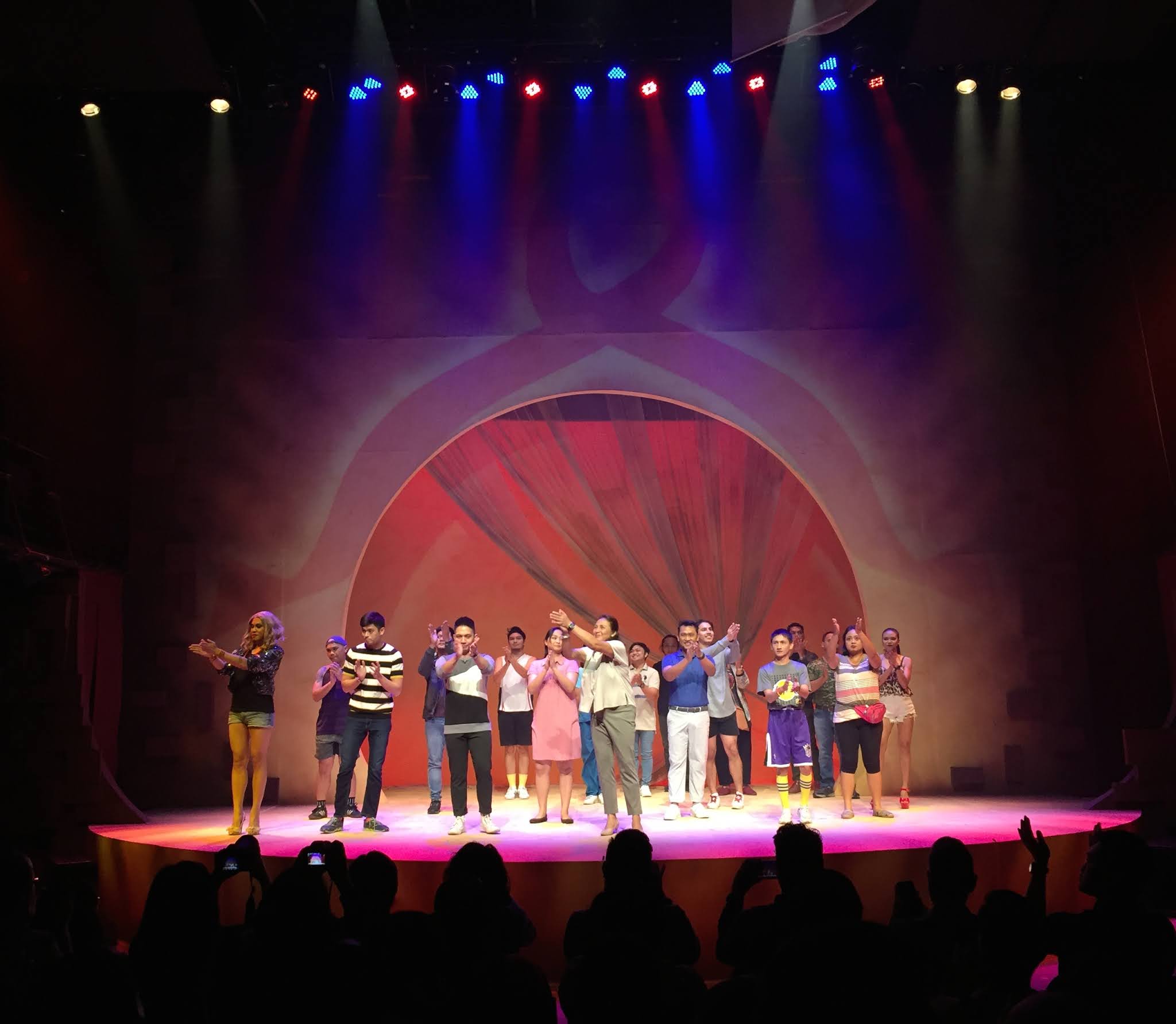
Wednesday, January 6, 2021

The Year in Philippine Theater (2020)

The annual theater yearender published in the January 4, 2021 issue of the Philippine Daily Inquirer, also accessible through the paper's website.

*     *     *     *     *

10 plays of remembrance and thanksgiving


This is not a best-of list of the kind we annually publish in these pages. Ten months into the pandemic, our stages remain hopelessly shuttered. The arts, from the looks of it, are barely on government’s main agenda.

So I write this as both remembrance and thanksgiving: a last glance at that seemingly alien time when we could still sit side by side in a darkened house; and a gesture of gratitude to how theater and its tireless makers have found ways to reach us, the audience, even in the midst of our social isolation.

Much of my “theatergoing” in 2020 was in the form of streamed theater—either archival recordings or altogether new pieces tailored to the virtual platform—and not just limited to Filipino works. Among others, I saw a modern-day adaptation of Anton Chekhov’s “The Seagull” from New Zealand; three new plays by Richard Nelson from New York’s The Public Theater; past London stagings of “A Streetcar Named Desire” (with Gillian Anderson) and “Red” (with Alfred Molina); and—what would have otherwise been an impossibility—Stephen Sondheim’s 90th birthday concert as it unfolded in real time.

This list is devoted to the Filipino landscape. Back in January of last year, I wrote about “10 things to look forward to” in Philippine theater. Now, taking stock of this annus horribilis for live entertainment, I leave you with 11 that made 2020 a little more bearable.


A university company tackling a rock musical about a family grappling with its matriarch’s bipolar disorder? In an ordinary year, this Ateneo Blue Repertory production would be topping yearend lists—and would have run longer. Directed by Missy Maramara, this was “Next to Normal” with its insides fully exposed— emotionally lacerating, deeply moving, with Cris Villonco and Jef Flores in career-best performances. It was the real deal.

2. Jaime del Mundo and Reb Atadero in ‘Amadeus’

Taal Volcano’s January 2020 eruption feels like a lifetime ago already. That Sunday, as ashfall slowly peppered the roofs and streets of Metro Manila, Del Mundo and Atadero delivered the year’s first great performances as Antonio Salieri and Mozart, respectively, in Company of Actors in Streamlined Theatre’s two-show-only staged reading of this Peter Shaffer play. 

3. Rody Vera’s script for ‘Under My Skin

Premiered by Philippine Educational Theater Association (Peta), Vera’s new play was more than just a Filipino face for the HIV-AIDS epidemic. It was also a breathtaking translation of complex science into dramatic language at once illustrative and accessible—suggesting how much better off we’d be if only our best scientists were also potent communicators.

4. ‘Joseph the Dreamer’

Trumpets’ revival of its musical take on the titular Bible story was a literal party. Fueled by Myke Salomon’s musical direction and MJ Arda’s choreography, this was RuPaul’s Drag Race meets dance concert meets Susan Sontag’s “Notes on ‘Camp’,” a church for the zany and unabashedly gay, with the divine Alys Serdenia presiding.

5. The theatricality of ‘Batang Mujahideen

What stayed with you was the sheer theatrical vision of this Tanghalang Pilipino (TP) play about the unending violence in Mindanao: the actors shifting characters and timelines in seconds; D Cortezano’s lights and Arvy Dimaculangan’s soundscape evoking the fever of war; the unnerving quiet of Lhorvie Nuevo’s turn as an extremist leader; bullets climactically raining down on the stage—all woven together by Guelan Luarca’s direction.

6. Open House roundtables

Part of Philippine Legitimate Stage Artists Group’s (Philstage) fundraising campaign for theater workers sidelined by quarantine measures was a series of roundtables streamed via Facebook. Beyond intimate peeks into the very craft of theater—the sessions gathered directors, sound designers, even critics (for which I was a discussant)—these roundtables were also early coping mechanisms, an admirable attempt at bringing together a newly splintered community.   

7. ‘Pilot Episode’ and ‘Wanted: Male Boarders, Vidjokol Edition’

At last year’s Virgin Labfest, the annual festival of one-act plays that marked the first major, collective effort in the country at “Zoom theater,” the best entries were the ones that figured out how to transpose to the screen a script that was originally intended for the stage. Part of what made “Pilot Episode” a brilliant visual explication of mental illness was its manipulation of multiple frames and cameras; “Boarders,” on the other hand, employed its ribald themes to its advantage, committing to the idea of the smartphone as stage (and arena for phone sex), in the process ruffling certain feathers and raising discussions on what constitutes “tasteful art.”

8. ‘The Price of Redemption’

In just 20 minutes, TP’s amalgamation of excerpts from this Anton Juan play, available on YouTube, is at once a perceptive deconstruction of “Zoom theater,” a (meta-)commentary on our lives in quarantine, and a fervid reminder that the Filipino’s fight for social justice is far from over.

9. 12th Gawad Buhay Awards

Disclaimer: I’m a jury member for these awards, which some amusingly compare to the Tonys. Let me say, then, that last year’s ceremonies, broadcast via Facebook and YouTube, were the most efficient of late (Tonys, take note)—showing how such events can be (relatively) concise yet also highly entertaining. Two of many highlights: Kakki Teodoro’s acceptance speech (I’m not crying, you’re crying!); and, halfway through, music icon Gary Valenciano’s soul-cleansing rendition of “Could You Be Messiah?”   


That Resorts World Manila’s jukebox musical “Ang Huling El Bimbo” reached seven million views and raised over 12 million pesos when it streamed for 48 hours last May was no mean feat. Now, as Manila-based companies release recordings of past shows online, either for free (as in the case of Tanghalang Ateneo on YouTube) or for a fee (like Peta’s “Care Divas” on KTX.ph), one implication is that, for the first time, these homegrown productions can be viewed by anyone anywhere in the country, even abroad. It’s a system that’s still figuring itself out, but it’s also one that points to a progressive way forward—a step toward a more democratic Filipino theater.


My personal temporal marker between the pre- and post-COVID days: As government announced the first lockdown measures in March, I was literally watching a preview of this Atlantis Theatrical Entertainment Group production, the cast giving what felt like the performances of their lives knowing full well they would no longer officially open. How ironic that this Broadway musical, about a troop of musicians arriving in the wrong town, depicted the beauty of human connection—that which the pandemic soon made us learn to fear. The production itself was first-rate, from Bobby Garcia’s direction, the design elements, to the pitch-perfect ensemble led by Vera and an incandescent Menchu Lauchengco-Yulo.

Saturday, January 2, 2021

The Year in Film and TV (2020)

Here we are again, at the end of another year of relentless downloading and watching. I'll skip the requisite intro on how it's been a particularly awful year, since I have that for my theater year-in-review coming out on Monday. 

I started a Letterboxd, finally, and according to my log I saw 285 films between January 1 to December 31, 2020, and I know that count's off by at least one or two shorts that aren't in the site yet. That number also doesn't include the TV series I consumed, including six seasons of "The Americans" (nothing compares!) and "Schitt's Creek"; four seasons of "Insecure"; two seasons of "Ramy," "What We Do in the Shadows," and the horrible "The Kominsky Method"; the disappointing "Lovecraft Country"; the mixed-bag "Little America"; the not-quite-there-yet "P-Valley"; and the lazy fourth season of "Fargo." 

The same annual disclaimer: This is a list of my favorite titles from this (2020) and the previous (2019) year, the latter to account for the "leftovers" that get screened quite late in the Philippines (such as Gerwig's "Little Women" and Mendes' "1917") or not at all. This is NOT a best-of-2020 list--but you may as well read it as such. If you're viewing this piece on desktop or mobile, there's a side bar to the right that lists everything I watched in the last 366 days. And if you're wondering why I've combined film and TV--which I started doing only last year--well, why not.

In order--though except for numbers one to four, the ranking barely matters, I think--my top 10 films and TV of 2020:


1. 'So Long, My Son' (dir. Wang Xiaoshuai)'A Sun' (dir. Chung Mong-hong)
A tie between these two Chinese-language masterworks, because why not? Both films are basically redemption stories, about sons clashing with their fathers, about parents struggling and failing to understand their children. If there's anything you need to know about Chinese culture, it's that family is everything--salve and source of scorn, beginning and end of the stories that matter--and both films get that with penetrative accuracy. "So Long, My Son" is almost a history of the Mainland writ small, from the Boluan Fanzheng era up to the 21st century, as seen through the eyes of two families; "A Sun" is a genre-bending stunner from Taiwan, following the lives of one family in the aftermath of a grisly crime. Each left my Asian heart full; each, despite running over two-and-a-half hours, left me wanting more.

2. 'I May Destroy You' (BBC/HBO; created by Michaela Coel)
The best shows don't only make you laugh, or cry, or laugh and cry; they also offer illumination, a new way of seeing things--and if you're lucky, a whole enough glimpse into another, better path forward. This is one such show.

3. 'Little Women' (dir. Greta Gerwig)
Pinnacle of literary adaptation. In the immortal words of one Saoirse Ronan, "Women!" Still can't believe this lost the Oscar, BAFTA, and WGA for Adapted Screenplay to, um, "Jojo Rabbit"! 

4. 'PEN15' Seasons 1-2a (Hulu; Maya Erskine, Anna Konkle, Sam Zvibleman & Gabe Liedman, showrunners)
Seasons 1 to 2a, that's right, because all 17 episodes so far have been nothing short of great. Coming of age has never been this fun, or funny. And also sad. And absorbing to witness.

5. 'Aswang' (dir. Alyx Ayn Arumpac)
This is not a movie. This is our lives now. #WhenWillDaddyDigzDie?

6. 'First Cow' (dir. Kelly Reichardt)
Reichardt really said, No to lazy viewers! Best Picture 2020, yes please.

7. 'Insecure' Season 4 (HBO; created by Issa Rae & Larry Wilmore)
Exceptional in the way it captures the tenor of real, functional-dysfunctional, mature-immature adult relationships. Shoutout to Natasha Rothwell's Kelly, MVP supporting character. 

8. 'Spontaneous' (dir. Brian Duffield)
Perhaps the most precise approximation of young love and/or falling in love in 2020. The teen rom-com, macabre humor, the apocalypse and post-apocalypse rolled into one. 

9. 'Mank' (dir. David Fincher)
The year's most clear-eyed, crushing yet compassionate depiction of the creative process. Vision! Talent! Commitment!

10. 'The Vast of Night' (dir. Andrew Patterson)
If the sensations of Shelley's "Ozymandias" were distilled into a thrilling gabfest of a movie. 

*     *     *     *     *

Thanks to Letterboxd for simplifying life for me. Here are the rest of my 5-star titles for the year, in alphabetical order:

'The Crown' Season 4 (Netflix; created by Peter Morgan)
Best season yet, largely because the series finally realized how it works best when it treats the Windsors for what they really are: spoiled brats who have no place in this world, except as fodder for gossip. And not one less-than-excellently written episode here!

'Driveways' (dir. Andrew Ahn)
Perfect little gem of a film. RIP Brian Dennehy.

'Fan Girl' (dir. Antoinette Jadaone)
A pleasurable, moths-drawn-to-the-flame electrocution. I love mess!

'For Sama' (dir. Waad Al-Kateab & Edward Watts)
My pick for Best Documentary Feature at the 92nd Oscars. Maybe doctor biases at play here.

'The Forty-Year-Old Version' (dir. Radha Blank)
I couldn't stop laughing, 1.

'Honey Boy' (dir. Alma Har'el)
Ninety-minute father-and-son emotional roller coaster. Excellent cardio substitute.

'Kalel, 15' (dir. Jun Robles Lana)
This greatly offended my devout Catholic mother, which is maybe the best endorsement for this all-around incredible film.

'Never Have I Ever' Season 1 (Netflix; created by Mindy Kaling & Lang Fisher)
Pinnacle of wholesome teenage comedy-drama. (Is there such a thing?)

'Never Rarely Sometimes Always' (dir. Eliza Hittman)
Gut-wrenching parable of our times, and a masterpiece of a fuck-you to all the male garbage of the world.

'Overseas' (dir. Yoon Sung-a)
That this documentary about Filipino women training to become OFWs is set in my hometown, the subjects speaking my local tongue, only made it cut even deeper.

'Rewind' (dir. Sasha Joseph Neulinger)
Best non-Filipino horror film of the year. Also my pick for best non-Filipino documentary of the year. 

'Schitt's Creek' Season 6 (CBC/Pop TV; created by Eugene & Dan Levy)
Peak "Schitt's Creek," as it completely let go of being just superb sitcom (a transition that began mid-Season 4) to become something more poignant.

'Sorry We Missed You' (dir. Ken Loach)
Chekhov's piss bottle. If this is really Ken Loach's farewell at Cannes, what a way to go! 

'Unbelievable' (Netflix; created by Susannah Grant, Ayelet Waldman & Michael Chabon)
Pinnacle of the police procedural. Merritt Wever: robbed of an Emmy!

'Watchmen' (HBO; Damon Lindelof, showrunner)
Pinnacle of superhero comic adaptation. Jean Smart: robbed of an Emmy!

'What We Do in the Shadows' Season 2 (FX; created by Jemaine Clement)
I couldn't stop laughing, 2.

PLUS--22 more titles not to sleep on, listed alphabetically:

'And Then We Danced' (dir. Levan Akin); 'Babyteeth' (dir. Shannon Murphy); 'Borat Subsequent Moviefilm' (dir. Jason Woliner); 'Cheer' Season 1 (Netflix; created by Greg Whiteley);  'City Hall' (dir. Frederick Wiseman); 'Dark Waters' (dir. Todd Haynes); 'Elehiya sa Paglimot' (dir. Kristoffer Brugada); 'End of the Century' (dir. Lucio Castro); 'Fourteen' (dir. Dan Sallitt); 'Gulis' (dir. Kyle Jumayne Francisco); 'How To with John Wilson' Season 1 (HBO; created by John Wilson); 'I Hate Suzie' Season 1 (Sky Atlantic/HBO Max; created by Lucy Prebble & Billie Piper); 'Normal People' (BBC Three/RTÉ One/Hulu; dirs. Lenny Abrahamson & Hettie Macdonald); 'Saint Frances' (dir. Alex Thompson); 'Schitt's Creek' Season 5 (CBC/Pop TV; created by Eugene & Dan Levy); 'Sound of Metal' (dir. Darius Marder); 'Unorthodox' (Netflix; created by Anna Winger & Alexa Karolinski); 'Waves' (dir. Trey Edward Shults); 'We Are Who We Are' (HBO/Sky Atlantic; created by Luca Guadagnino, Paolo Giordano, Francesca Manieri & Sean Conway); 'Welcome to Chechnya' (dir. David France); 'What We Do in the Shadows' Season 1 (FX; created by Jemaine Clement); 'The Wild Goose Lake' (dir. Diao Yinan)

*     *     *     *     *

I don't have a performance of the year for 2020--because a case can be made for each of these 25, in alphabetical order:

1. Riz Ahmed ('Sound of Metal')
2. Jennifer Aniston ('The Morning Show' Season 1)
3. Maria Bakalova ('Borat Subsequent Moviefilm')
4. Rose Byrne ('Mrs. America')
5. Elijah Canlas ('Kalel, 15' & 'Babae at Baril')
6. Viola Davis ('Ma Rainey's Black Bottom')
7. Brian Dennehy ('Driveways')
8. Charlie Dizon ('Fan Girl')
9. Julia Garner ('The Assistant')
10. Jack Dylan Grazer ('We Are Who We Are')
11. Zoe Kazan ('The Plot Against America')
12. Paul Mescal ('Normal People')
13. Cristin Milioti ('Palm Springs')
14. Elisabeth Moss ('The Invisible Man')
15. Josh O'Connor ('The Crown' Season 4)
16. Catherine O'Hara ('Schitt's Creek' Seasons 5-6)
17. Billie Piper ('I Hate Suzie' Season 1)
18. Aubrey Plaza ('Black Bear' & 'Happiest Season')
19. Florence Pugh ('Little Women')
20. Gina Rodriguez ('Kajillionaire')
21. Amanda Seyfried ('Mank')
22. Jean Smart ('Watchmen')
23. Meryl Streep ('Let Them All Talk')
24. Merritt Wever ('Unbelievable')
25. Yong Mei ('So Long, My Son')

PLUS--25 more performers whose works I wholly recommend:

Ben Affleck ('The Way Back'); Paulo Avelino ('Fan Girl'); Antonio Banderas ('Pain and Glory'); Elizabeth Banks & Ari Graynor ('Mrs. America'); Reed Birney ('The Forty-Year-Old Version'); Hong Chau ('Driveways'); Olivia Colman ('The Crown' Season 4); Carrie Coon ('The Nest'); Paul Walter Hauser ('Richard Jewell'); Ethan Hawke ('The Good Lord Bird' & 'Tesla'); Lucas Hedges ('Let Them All Talk' & 'Waves'); Nicole Kidman ('The Undoing'); Shia LaBeouf & Noah Jupe ('Honey Boy'); Phi Palmos ('Kintsugi'); Charlie Plummer ('Spontaneous'); Jeremy Pope ('Hollywood'); Amit Rahav ('Unorthodox'); Saoirse Ronan & Timothée Chalamet ('Little Women'); Wu Chien-ho & Liu Kuan-ting ('A Sun'); Ramy Youssef ('Ramy' Season 2); Renée Zellweger ('Judy')

*     *     *     *     *

5-Letterboxd-star, non-2019/2020 titles that I saw for the first time in 2020: 

'All About Eve' (1950, dir. Joseph L. Mankiewicz)
'Batch '81' (1982, dir. Mike de Leon)
'The Big Lebowski' (1998, dir. Joel Coen)
'Kisapmata' (1981, dir. Mike de Leon)
'One Cut of the Dead' (2017, dir. Shinichiro Ueda)
'A Rustling of Leaves: Inside the Philippine Revolution' (1988, dir. Nettie Wild)

*     *     *     *     *

FILMED THEATER

With live theater shut down, avid theatergoers like myself had to content ourselves mostly with filmed recordings of past shows. Here are the 5-star productions I recommend you run after, if you've yet to catch them (years indicate the cinema release or streaming premiere):

'Act One' (2015, Broadway premiere, Vivian Beaumont Theatre, Lincoln Center)
Loved this play and loved this production, but I loved the physical casting most of all. Tony Shalhoub as Older Moss Hart, Santino Fontana as Younger Moss Hart, and that kid as Kid Moss Hart is the definition of 'family resemblance'.

'All My Sons' (2011, West End revival, Apollo Theatre)
One of those casts you wish you could have seen live, with Daniel Lapaine's George Deever as the standout.

'Company' (2008, Broadway revival, Ethel Barrymore Theater)
My definitive "Company." 11/10 would recommend to anyone who wants to get into Sondheim, or musical theater, or both.

'Coriolanus' (2014, London revival, Donmar Warehouse)
Talk about sense of fcking space.

'Falsettos' (2017, Broadway revival, Walter Kerr Theater)
Stephanie J. Block losing the Tony for Featured Actress in a Musical is what? Homophobic.

'Hamilton' (2020, Broadway premiere, Richard Rogers Theater)
My hot take: It's pretty good. 

'She Loves Me' (2016, Broadway revival, Studio 54)
Shallow and pretty and intent on having an all-around old-fashioned good time. Come for Laura Benanti, stay for Zachary Levi. The Tony for Scenic Design (beating "Hamilton") was the definition of justice.

'South Pacific' (2010, Broadway revival, Vivian Beaumont Theatre, Lincoln Center)
Revelatory revival of an old dame, thanks to Bartlett Sher. And Kelli O'Hara--a goddess on earth.

'A Streetcar Named Desire' (2014, London revival, Young Vic)
Tennessee Williams for the #MeToo era.

*     *     *     *     *

A link to my past lists. Interesting time capsules, these lists, as I don't necessarily agree with some of my choices anymore.

The Year in Film 2018/ 2017/ 2016/ 2015/ 2014

Monday, December 28, 2020

PDI Opinion: Beyond the social media bubble

In today's Inquirer, a rant--here.

*     *     *     *     *

Beyond the social media bubble

Recently, I was involved in a project that gathered the narratives of people who use drugs in the urban poor. In one Zoom meeting, the senior anthropologist of our team told us about a striking observation from a similar work. "It's easy for us to see that every single tokhang victim can be traced back to Duterte himself," she said. "But ordinary people in the communities don't always share this view. They can be angry at the police who violated their homes, or the masked assailant who killed their loved ones, but again and again I was told 'it's not Duterte's fault,' or, 'we can't blame the President for everything that's happening in the country.'"

I was reminded of this anecdote yet again on the morning of Dec. 21, roughly 12 hours after the deaths of Sonya and Frank Anthony Gregorio in the hands of Tarlac police officer Jonel Nuezca. That's really all you need to know about the crime: A Filipino policeman murdered two defenseless Filipino citizens in broad daylight.

As video footage of the incident went viral, social media was in uproar, the online furor nowhere more deafening than on Twitter. And it was so easy to believe that the unending deluge of tweets condemning the murders, demanding accountability across all levels of government and the police force, meant the entire nation was actually angry that day--that in every pocket of this archipelago, people were united in a state of rage, horror, and disbelief. It was easy to forget, no matter how many times this has been said, that the virtual world is but a bubble--and in the case of the Philippines, hardly anything like the "real" world.

Which begs the question: What do you do after posting that carefully worded series of tweets that gets shared by tens of thousands, or after typing the final period to that kilometric Facebook essay replete with academic references? What's next after you like and share that tweet or post or on-point meme?

The thing to understand about impunity in the police force is that it's not, to use the term Mr. Duterte's minions have desperately clung to in describing Nuezca's act of murder, "isolated." What I mean is, it's not only in the police and government where a culture of impunity thrives unchecked.

Seeing people call out the so-called "good cops" for staying silent, I couldn't help wondering: Where were these people when shit closer to their respective homes hit the proverbial fan? Because when doctors choose to stay silent over Health Secretary Francisco Duque III's weak-kneed handling of the pandemic, and when those working in private institutions simply watch as these institutions attempt to pass the burden of COVID-19 to public hospitals, that is also impunity. When writers choose to stay silent while a National Artist for Literature and a national writing workshop blatantly support the government's drug war, that is also impunity. And when lawyers and political scientists choose to stay silent as their former professors and current colleagues abet the running of this country to the ground, that is also impunity.

Obviously, not all doctors, and writers, and lawyers, etcetera.

Allow me, then, to further extend the Wieselian thought (the original being that "silence only helps the oppressor"): When all we do is make noise online, and only on matters that are beyond our own backyards, we are actually barely helping. I am not saying there is no point in voicing out our anger. I am saying we need to carry that anger into the real world. I am saying we need to walk the (virtual) talk.

There is a world beyond social media, its thought-provoking discourses and clout-chasing influencers. It may contain your neighbor who is proudly "apolitical." Your sibling who is a "timeline cleanser." Your parents' business partner who still supports Mr. Duterte because "he is good for business." Your lawyer friend who views the law as words on a page, and not something that should have moral and ethical guideposts. Hundreds of thousands of people who don't even use Twitter, and probably haven't seen, or heard, or seen and heard what Nuezca did on Dec. 20.

Amid this pandemic, which has worked so well to government's advantage in that it has become easier than ever to suppress organized action and stamp out dissent through covert operations, disrupting the fragile comforts of our polite and decent circles is maybe the best that we can do to bring the "discourse" outside our virtual echo chambers. This, too, will never be enough. But it can be a start.

Tuesday, October 13, 2020

PDI Opinion: Iloilo as Wakanda

New commentary in today's Inquirer--website version here. Let me just add that coming home prior to the start of the March lockdown was the best decision ever.

*     *     *     *     *

Iloilo as Wakanda

ILOILO CITY--Perhaps it's time we stopped referring to this city as the Philippine Wakanda. The title, referencing the fictional African utopia integrated into everyday language by the 2018 superhero film "Black Panther," aptly captured how local leadership marshaled its own pandemic response during the first half of the year, when the national government couldn't even get its act together. These days, however, the moniker is being tossed around in various other contexts, a placeholder asserting this idea of the city as an infallible paradise.

One recent instance involved the Iloilo River Esplanade: On Twitter, it was hailed as a paragon of nature-friendly public infrastructure, the antithesis to that brainless dolomite beach reclamation in Manila Bay.

Separately, as authorities grappled with the rise of biking in Metro Manila--and preoccupied themselves with how best to earn from it--netizens swiftly pointed out how Iloilo already provided a model for this "new normal," justifying this claim with images of the eight-lane Diversion Road with its companion 11-kilometer bike lane. (So picturesque is the highway, in fact, that a year ago, pro-Duterte trolls even circulated a photo of it, claiming it was a picture of Davao City.)

A more clear-eyed perspective would celebrate the long-term vision that doubtless informed these projects--boosting the city's "habitability" and its attractiveness to tourists and investors--while also acknowledging their consequential imperfections.

A quick online search, for example, easily reveals how these esplanades, now stretching several kilometers, came at the expense of the original river flora. As late as two years ago, mangroves lining the river were still dying, as the construction work disrupted the tidal flow and water salinity necessary for the plants' survival. (Good news, though: A mangrove-replanting scheme has, from the looks of it, by far succeeded.)

And while anointing the city as the country's "bike capital" may not be totally off-base, at the very least it conveniently ignores, if not altogether erases, the local lived reality--how the past decade's mad rush to rehabilitate (and even "re-rehabilitate") the city roads, in a place with barely the inherent space to accommodate sprawling, simultaneous road works, meant month after month of perennial, time-consuming congestion spilling across districts.

This is not to diminish the achievements of a city whose push for progress has remarkably included green spaces and cultural heritage in the picture. But in the age of virtual information warfare, a nuanced perspective must always prevail, more so in instances touting supposed progress. In other words, facts--and therefore clarity--above all else.

Scholars have long noted the political nature of names: The very act of naming spawns its own power structure, eventually influencing future thought and action. Iloilo itself is no stranger to the politics of nomenclature: Remember back when someone declared it the "most shabulized city" in the country?

The present case is the complete opposite. Now we're dealing with a name connoting invincibility and impenetrability, at such a critical juncture in contemporary history. The danger, then, in ascribing a status of implied superiority to a single place goes beyond mere misrepresentation. It warps public consciousness, birthing instead an idea of the place that's devoid of imperfection and immune to criticism. To go by a tenet of propaganda, repetition is key to creating the reality. Keep upholding this myth of the Ilonggo Wakanda, and soon you'll have anything but. (In this era of right-wing populism, you might even get an army of blind believers to back you up.)

If there's anything the last four years in Philippine politics have taught us, it's that too much belief in something--or someone--eventually blurs the line between fact and fiction, blunting our collective judgment.

Our cities, and our leaders, should not be placed on pedestals. They must always be rendered on a human scale--to be praised where praise is due, and to be held accountable for their every shortcoming. 

For Iloilo, that may mean commending its government for the way it has handled the pandemic these last six months (establishing accessible mass testing, sustaining open lines of communication, nurturing public-private partnership, etc.). But even this commendation should go hand in hand with recognizing that these mechanisms haven't always been perfect or fully effective in curbing the threat of COVID-19.

Such a duality, in the bigger scheme of things, should be enough. Anything more--anything subscribing to ridiculous superlatives, like this perpetration of the Wakandan analogy--is unnecessary, and may even prove damaging in the long run. 

Monday, September 28, 2020

PDI Feature: On virtual theater

Major-ish news: The Philippine Daily Inquirer's Theater section has been absorbed by Arts and Books (where theater articles used to appear before November 2012). The move makes sense, of course, given how local theater has been at a standstill for the last six months. My first essay under this new arrangement appears in today's paper, and contrary to what the headline makes it sound like, I am in fact not the biggest fan of virtual theater. See you in this same space next month, probably. The website link to the article here.

*     *     *     *     *

Is virtual theater the future of the PH stage?

Four months ago, a video recording of "Ang Huling El Bimbo" streamed for free on Facebook and Youtube as part of ABS-CBN's fundraiser for the new coronavirus disease (COVID-19) pandemic. In just two days, the musical reached seven million views and raised over 12 million pesos.

Those were unquestionably impressive numbers, though to be fair, "El Bimbo" was an easy sell. A massive hit at Resorts World Manila, where it played 115 performances in the span of a year to some 150,000 people, it could rely on solid word of mouth. The show's use of the Eraserheads' music was also an attraction in itself, and would have lured even those who did not identify as theatergoers but were fans of the seminal band. Plus, the audience was already essentially "present": Anyone with internet access anywhere in the world could watch the show--and donate to the cause.

Nonetheless, the case of "El Bimbo" proved that, with the proper publicity and the "right" material, there can be a future for streaming theater in the Philippines. The question now--six months into this crippling pandemic--is how to make it work. One may as well begin by stressing the importance of the quality of the recording. This was never a problem for "El Bimbo"; at Resorts World Manila's Newport Performing Arts Theater, the shows were always accompanied by a "live recording," as strategically stationed cameras beamed the ongoing performance on either side of the stage. (Suddenly, what used to be a distracting feature of the theater became its asset.)

But "El Bimbo" was a rarity: Numerous companies also released archival content on the internet, such as Dulaang Unibersidad ng Pilipinas' "Ang Nawalang Kapatid" and Philippine Educational Theater Association's "William"--but often, these recordings were poorly captured and frustrating to watch.

And in any case, "El Bimbo" was no global pioneer. London's National Theatre and New York's Lincoln Center have been in the business of streaming theater for years, recording their shows as if they were shooting films and releasing them in cinemas or through broadcasters like PBS. In fact, when the pandemic struck and London theater shuttered, the National Theatre was one of the first to launch these online shows-for-a-cause initiatives. For Filipino viewers, that meant free and previously impossible access to Tom Hiddleston's "Coriolanus," for example.

But is such a model sustainable in the Philippines? If, for example, in a postpandemic world, "El Bimbo" were to hold regular cinema screenings, would enough people pay to see it?

It's a tricky question to navigate at the moment, and using First-World examples such as the National Theatre, or even "Hamilton's" tie-up with Disney+, to assert the financial viability of this future won't be very convincing.

It's even trickier for original material--this alien thing we now call virtual or "Zoom" theater, after the video conferencing app that artists worldwide have used as a stage. Now the question starts at the time of inception: Playwrights must now tailor their material to the virtual media, with Zoom screens in mind, while actors, directors and designers must navigate their craft in this strange in-between of film and physical theater.

The early local examples can be seen as stepping stones to this forced transition. Playwright Layeta Bucoy, for instance, wrote for Tanghalang Pilipino a trilogy of "monovlogs" that tried to unpack the human experience of COVID-19, the second installment of which starred screen legend Nora Aunor as the eponymous "Lola Doc." Gabay Kalikasan, an advocacy arm of PLDT-Smart, did a couple of revues employing many from the cast and creative team of "El Bimbo"--first, "Songs for a Changed World"; then "Tatsulok: A Trilogy for Change."

The recent Virgin Labfest, the Cultural Center of the Philippines' annual festival of new one-act plays, might just be the biggest such effort yet--and perhaps the most insightful.

For one, the most successful entires of this year's edition, which unfolded on the video platform Vimeo, were those that figured out how to transpose to the screen a script that was originally intended for the stage, such as Floyd Scott Tiogangco's "Pilot Episode," which surely benefited from having filmmaker Giancarlo Abrahan ("Dagitab," "Sila-Sila") at the helm. And as longtime festival production manager Nikki Garde-Torres shared, the dip in this year's revenues was countered by a huge rise in viewership--audiences from a wider geographical catchment--reflected in the postfestival numbers.

Especially in the past decade, Filipino theater has often been touted to be a "booming" industry, but in fact what this "theater" refers to has been largely confined to the stages of Metro Manila--the unfortunate product of, among other factors, theater journalists of prominent publications being mostly based in the capital and therefore covering only shows in that region; and the congregation of talent, from professional theater companies to universities with reputable training programs, in that same, insular space.

Virtual theater is just about our best answer now to solving this question of access--of whose theatrical creations get to be seen and who gets to see these creations.

Live theater is irreplaceable. But now we must also embrace virtual theater, whether streamed recordings of existing shows or completely new productions, as a vital part of the landscape. Doing so will not only be in support of sustaining the art form while the pandemic rages on; it will also be a step toward realizing a truly democratic Filipino theater.

Sunday, June 28, 2020

PDI Review: Virgin Labfest 16

Nearly three months since my/our last piece for the Theater section! Due to space issues (because print media in the time of COVID-19), this piece has been split into two parts, published yesterday (part 1) and today (part 2). I'm putting it here in the original, unbroken form.

*     *     *     *     *

Virgin Labfest: PH experiences its first 'virtual theater'


Under ordinary circumstances, the Cultural Center of the Philippines would have resembled a pilgrimage site of sorts these last three weeks, as Virgin Labfest, the annual festival of "untried, untested, unstaged" one-act plays, holds its 16th edition from June 10-28.

But this is no ordinary time: A pandemic rages across the world, with ill-equipped, populist leaders in charge of governments, to our global misfortune.

In Manila, live entertainment has been at a standstill for 15 weeks, resulting in thousands of displaced individuals and hundreds of millions in financial losses.

What's the Filipino theater artist to do in the face of unprecedented crisis where physical proximity in a live performance is a no-no?

If you're JK Anicoche, newly installed festival director of Labfest, you forge on, doing what theater artists around the world have done the past three months--migrating online and making do with "virtual theater." The festival theme "kapit" ("hold on") couldn't have been more apt.

Substitute for live theater

One wonders what the German cultural critic Walter Benjamin would have to say about this new arrangement. In his 1935 landmark essay, "The Work of Art in the Age of Mechanical Reproduction," Benjamin briefly distinguished theater from film through two elements: the presence of camera for the latter, and a physical audience with whom the stage actor interacts constantly for the former.

But Benjamin didn't have to deal with a pandemic, nor could he have foreseen the rise of the internet, which has not only influenced how we "reproduce" and "distribute," and thus "view" and "consume" art, but which can now dictate the very creation of art itself. Especially in light of the pandemic, the distinctions laid out by Benjamin aren't so much rendered pointless as placed in positions that demand careful reflection and reconsideration.

There can be no substitute for live, physical theater as we've known it, but one might as well make room for this new "virtual" theater--works that aren't just filmed versions of live performances, but created, designed and intended to be performed for the virtual space.

While we look forward to finally returning to watching theater in real time as an intimate crowd, it is necessary, if only in the meantime, to explore what it means to be writing scripts with streaming platforms in mind; directing and performing for the unseen but ever-present audience; even presenting shows in a country where decent internet connection--the basic requirement of virtual theater--isn't common.

The nine works of this year's Labfest prompt discussion of those questions. (The 10th play of the original lineup, Dustin Celestino's "Doggy," has been pulled out of the festival.)

'Pilot Episode': Brilliant

The best of the nine is Floyd Scott Tiogangco's "Pilot Episode"--not only a cut above the rest, but also inarguably the first great Filipino play of the quarantine. The writing is a brilliant explication of mental illness, honest and compassionate in its portrayal of the cycle of helplessness that hounds not just the patient, but also the patient's loved ones, to an almost normalized degree.

The advantages of having a filmmaker at the helm are instantly recognizable. But more than just his evident grasp of working on screen, director Giancarlo Abrahan actually lends the medium of film to heighten both the storytelling and the theatrical production, instead of insisting that the theater adjust to preconceived demands of film.

The play's first half is a straightforward monologue, with Phi Palmos (in one of the year's finest turns as the bipolar protagonist) acting straight before the camera (and thus, the viewers).

The second half is a tour-de-force dramatization of a manic episode in the life of the character, who lives with his parents (Missy Maramara and Jojit Lorenzo, providing excellent support). Six rectangular screens are present throughout, as each actor shoots from two differently positioned cameras at home.

By merely playing with the screens--the "positioning" of the actors, how many screens they occupy in a scene, even the way they appear, disappear, or are cut within a screen--Abrahan is able to capture the internal and external struggles of mental illness, and renders the confusions of mania--the flight of ideas, the fluctuating emotions and energies--in surprisingly accessible and evocative terms.

The "editing" and "production design" even succeed in granting the play a sense of visual and narrative continuity.

'The Boy-boy & Friends Channel': Fine sketch comedy

Anthony Kim Vergara's "The Boy-boy & Friends Channel," directed by Joshua Tayco, also lends itself well to the virtual medium.

The play is about four friends who run one of those Youtube channels that put out inane, if selectively entertaining, content. And the inanity is reflected foremost in the use of comical (and comically cheap) visuals, from Zoom backgrounds to outlandish physical gestures (mostly care of Gabo Tolentino, a hoot as the quartet's tattoo artist friend).

The treatment is, in a way, meta: On stage, the play would have unfolded with the audience located "inside" the physical space where the characters are shooting their Youtube content; now, the viewer watches from the other side of the "camera," chunks of the play unfolding as the supposed video recording.

The play itself is too long, takes unnecessary detours, and ends unconvincingly. But when it's good, it's really good, Vergara's writing calling to mind the finest moments of sketch comedy shows like "Bubble Gang" and "Ispup," but for the Duterte era. And the perfect casting includes Jerald Napoles and Anthony Falcon, so believable as the kind of people who would casually poke fun at Duterte's drug war on their Youtube channel, that you wonder just where the script ends and the improv begins.

'Titser Kit': A marvel of simplicity

Jobert Grey Landeza's "Titser Kit" is the opposite of Vergara's play. A conversation in a school storage room between a new student, who happens to be lumad, and the teacher who is his sole friend and confidante, it is devoid of noise and is a marvel of simplicity.

Director Adrienne Vergara's "staging" evokes the limits of the play's intimate physical (as well as social) space with just two alternating camera perspectives and through the clever use of close-ups.

The play, however, is riddled with a clumsy eagerness to arrive at moments of poignancy by way of nostalgia-as-exposition. Nevertheless, in the instances that it does land those moments, in the quiet gestures and small pauses of its actors (IO Balanon and JM Salvado as teacher and student, respectively), it becomes a deceptively simple but no less illuminating discourse on the unspoken trauma of children from violence-stricken places.  

'Multiverse,' 'Papaano Turuan ang Babaw Humawak ng Baril': Ravishing visuals

The inelegant handling of emotion also marks Juliene Mendoza's "Multiverse," one of two plays that know exactly what they want to achieve with their visuals--and execute those visuals with ravishing effect (the other being Daryl Pasion's "Papaano Turuan ang Babae Humawak ng Baril").

"Multiverse," directed by Fitz Bitana, runs away with its visual conceit, merging the superhero comic books of Marvel and DC with arcade video games of old. It also has the perfect stars (Iggi Siasoco and Vino Mabalot) to exude the mile-a-minute energy of its story of two brothers who rekindle bonds after the younger one's catastrophic spiral into alcoholism.

But the story's stumble into all-too-convenient melodrama is its undoing--when it starts rubbing emotions on the viewer's nose and relies on a disingenuous twist for its climax.

Pasion's play, on the other hand, looks like an oil painting, with its almost-static background of the light-deprived interiors of a meager home. The writing is also the festival's most poetic and lyrical--and to a certain extent, succeeds in intimating the personal change that affects the protagonist, a military underling's lowly wife who must finally confront the senseless violence that has long plagued her husband and her community.

But the play is overwritten, and combined with Erika Estacio's loose direction, comes across as a play of big moments and big emotions stifled by its technological platform, and too engrossed with its poetic and lyrical qualities. It also makes you wish to see Lhorvie Nuevo tackle the role of the wife onstage; here she can be affecting, but only to a degree.

'Mayang Bubot sa Tag-araw,' 'Blackpink': Burdened by narratives

Meanwhile, two plays feel more burdened than buoyed by the narrative messages they are so preoccupied with delivering.

Norman Boquiren's "Mayang Bubot sa Tag-araw," directed by Mark Mirando, apparently wants to bring to light the desecration of ancestral lands of indigenous peoples in the country, but spends an inordinate amount of time skimming the surface and dwelling on petty and less insightful matters. As the closest this festival has to outright protest theater, the play seems hesitant to dramatize the issues that demand dramatizing (relegating those to its final 10 minutes), or perhaps, too overwhelmed by the issues it initially sought to tackle.

It's even more baffling with Tyron Casumpang's "Blackpink," directed by Jethro Tenorio. It positions itself as progressive, an ally of the LGBTQ community, in creating the characters of a father who has long accepted his son's homosexuality, and of the son whose family rallies behind him to fight for his right to dance to a Korean girl group's song in the school talent show.

But as the characters unravel--the "gay" son reveals he is straight, and at one point, the father dictatorially commands his sons to admit to their homosexuality in the name of self-acceptance--the play becomes more confused, and ends up dropping its agenda in favor of a "fun" and "family-friendly" conclusion.

"Blackpink" is not exactly "I have gay friends, so I can't be homophobic" made manifest, but it sure resembles that friend who claims to be an ally, but nonetheless proceeds to bully (and betray) you, and ultimately tells you to forego and forget politics in the name of "friendship."

'Dapithapon,' 'Gin Bilog': Fragmented

As for Jay Crisostomo IV's "Dapithapon," directed by Sig Pecho, and Luisito T. Nario's "Gin Bilog," directed by James Harvey Estrada, what's most striking is how the translation from stage to screen seems to have significantly lost the written work's essence.

"Dapithapon" is a nostalgia trip for those who miss their adolescence in the presocial media age. Its day-in-the-life story of three boys in the twilight of high school thrives on dick jokes, bathroom humor, and just tons of broad comedy that it doesn't land all the time.

But onscreen, the energy the play would have derived from portraying three hormonal teenagers in a single space is now fragmented and muted, so much so that the arrival of Ina Azarcon-Bolivar (as the larger-than-life teacher) late in the play becomes such a welcome disruptive force.

The fragmentation and lost-in-translation effect is worse for "Gin Bilog," an absurd comedy about three drunks whose night gets out of hand and ends morbidly. It would be pretentious to say with certainty how this play could have transpired on a physical stage, but this virtual version unfortunately comes across as rudimentary in so many ways, from the attempts at animation to the strangely catatonic delivery of the comedy.

'Wanted: Male Boarders,' 'Jenny Li': Utter delight

Instead, the other runaway success of this Labfest is in the Revisited section (traditionally, the three plays from the previous year chosen to return for the current season).

Rick Patriarca's "Wanted: Male Boarders," which distilled its central theme--that prejudice is learned, and can be unlearned--into its go-for-broke telling of three hypermasculine guys who must learn to live with their gayer-than-gay new housemate, now comes with a subtitle: "Vidjokol edition."

Pacing issues notwithstanding, what an utter delight this play directed by George de Jesus III has become. Not only does it makes punchlines out of the notion of phone and video sex in the age of smartphones, it has also fully committed to the idea of the smartphone as the stage, and cleverly situates itself in the time of the pandemic--which means TikTok, Snapchat filters, freezing screens, Kim Chiu's "Bawal Lumabas," Lady Gaga and Ariana Grande's "Rain on Me," and so forth.

The result is a completely new staging that would no doubt merit a spot in the Revisited section.

And among the staged readings we've caught, Buch Dacanay's "Jenny Li," directed by Nour Hooshmand, is one that demands to be seen.

It's ridiculous to call this a staged reading (it's a fully staged virtual production, come on!), and its use of a twist as dramatic device may comes across as deceptive and counterproductive in the context of the story it wants to tell.

But this is a play that addresses the unending issue of rape, male predatory behavior, and the exceptional bravery it always takes for victims to come forward--and does so with remarkable empathy and clearheadedness. A spot in the featured works section would have been more than deserved.

Friday, June 26, 2020

I Have Moved to TinyLetter

Just a PSA for anyone who still visits this space (thank you, I really appreciate it). This blog will now just be an archive of my published work. For the diary/ drama/ personal eme, subscribe to my TinyLetter: 

Saturday, April 4, 2020

PDI Feature: Impact of COVID-19 on Filipino theater companies

Cora and I do the numbers and economics in today's theater section--here. I can only hope I never again see in my lifetime the theater community besieged by something as crippling and monstrous as this pandemic.

*     *     *     *     *

'Sometimes, the show can't go on': How Filipino theater tries to cope

Twenty-eight productions of 22 companies in Metro Manila have been affected so far by the new coronavirus diseases (COVID-19) pandemic, which forced the government to lock down Luzon and suspend all public gatherings.

From a public health perspective, the move was necessary.

Yet, one simply cannot ignore the economic repercussions of this unprecedented shutdown.

"Theater is time-bound and time-sensitive. Very few productions are able to circumvent the idea of 'It's now or never,' which is why 'The show must go on' has become synonymous with the performing arts," says Pangasinan Rep. Toff de Venecia, the managing artistic director of The Sandbox Collective. "But COVID-19 is a different monster altogether. It has caught everyone in the industry off-guard."

Sandbox canceled 14 performances of a 16-show repertory run of "Lungs" and "Every Brilliant Thing," its two hit nonmusical plays from 2018 and 2019, respectively.

Postponing a single weekend of shows alone, De Venecia says, would already incur a loss for the company, as it grapples with "venue availability vis-à-vis the preferences of both ticket buyers and show buyers for rescheduled performances. What more postponing the whole run."

According to an industry insider, mounting a typical four-weekend run of an English-language nonmusical play by a non-Filipino playwright--covering licensing, salaries, production costs, administrative work and marketing--now costs anywhere between P2 and P4 million. A musical of similar pedigree costs at least P10 million.

For productions of homegrown material--without the need to pay for licenses and royalties overseas--the costs run anywhere between P800,000 (the minimum for nonmusical plays) and P2 million (the usual maximum for musicals).

To break even, or recover expenses, a production would have to net at least 15-20 percent return of investment. This translates to 50-60 percent capacity for every performances--which is hardly the case in the local theater scene, where audiences usually start filling houses only past the second weekend, from word of mouth.

Productions by university companies cost less to mount--according to another insider, P50,000 to P200,000 for a straight play, and around P1.2 million for a musical.

Student-run

Of the 28 productions sidelined by the pandemic, 13 were by student-run theater organizations or university theater arts programs.

That included Ateneo Entablado's (Enta) "Macli-ing," which had only the first of its three-week run; Ateneo Blue Repertory's (BlueRep) "Next to Normal," with a sold-out five-show opening weekend; and Tanghalang Ateneo's (TA) "Top Girls," which never got to open.

Collectively, they incurred P1,121,011.39 in losses, according to the Council of Organizations of the Ateneo.

Missy Maramara, director of "Next to Normal," says: "In student-run companies, the students raise the funds, make the decisions and do the legwork. We apply for grants from the school; we don't get automatic subsidies. The university support comes in the form of minimal expenses for the use of the venues. So our only streams of revenue are ticket sales, sponsorships and the occasional gig."

According to Maramara, "Next to Normal" lost around half a million pesos because of cancellations. "Productions of the following year are dependent on the financial capacity of the previous year, so it's a deficit the company will bring over to its next production."

This snowball effect is felt not only on a micro level (e.g., detailed finances), but also on a macro scale (e.g., the planning of a company's entire season).

Sandbox's sister company, 9 Works Theatrical, has postponed one of two productions set later in the year for next year, says managing director Santi Santamaria.

The 11-year-old company's original lineup included a new jukebox musical using the songs of former Rivermaya frontman Rico Blanco, and the stage adaptation of the Whitney Houston vehicle "The Bodyguard."

No opening night

Atlantis Theatrical Entertainment Group has preemptively canceled its production of "Oliver!," set for June. Its maiden offering for 2020, "The Band's Visit," managed only a couple of invitational technical dress rehearsals (March 11-12) and shuttered before opening night.

Repertory Philippines' (Rep) "Anna in the Tropics" never got to open, while its "Carousel," to be directed by De Venecia and originally set for May, has been postponed.

"Batang Mujahideen," the production of Tanghalang Pilipino (TP), resident theater company of the Cultural Center of the Philippines (CCP), was the earliest casualty of the pandemic.

Even before its late-February opening night, it already had to cancel five of its 12 performances, as the schools that bought those shows backed out in compliance with the Department of Education's memorandum on prohibition of educational trips.

Despite losing roughly P400,000 from those canceled shows, however, artistic director Fernando "Nanding" Josef chooses to think of TP as somehow lucky. "The onset of the epidemic happened at the tail end of our season. Our Actors Company (AC) and staff were psychologically prepared for the 'off-season' mood, and the show itself was well-received by audiences and critics, so morale did not get too low. Plus, one of the show buyers that backed out instead transferred its reservation to the rerun of 'Lam-ang' in September."

In the meantime, some reevaluation of existing structures and internal policies is needed--what Josef calls starting "a solid, sustainable program of in-depth reflection, analysis and new creative collective action."

Strong business sense

Rep artistic director Liesl Batucan, for one, notes that "there are advantages to being a company that's been in the business for a long time. [Late company cofounder] Tita Bibot Amador ran Rep very well; she had a strong business sense. Now we have financials--not a lot, but enough to help us not shut down the whole year--and the human resource infrastructure."

As Santamaria puts its, "Unlike normal businesses that are accustomed to monthly income flow, theater has trained us to be naturally prudent, as we only really earn or lose income whenever we have a production."

It's this ephemeral nature of local theater that De Venecia sees as both boon and bane. "It's a kind of cushion in that we don't have tremendous overhead, as opposed to those who maintain facilities or have regular employees. But as arts organizations, our engagement with audiences is seasonal and transactional. We put up a show, engage with paying audiences and disengage soon after--which is maybe why theater companies work so hard to scream in a crowded market to attract fickle audiences.

"As producers, we can't not look ahead; we still have to make plans and provisions for future programming. But if anything, this pandemic has compelled micro-, small and medium enterprises such as ours to start thinking medium-term rather than short term--to think of plan B or C in light of force majeure."

Moving forward, after all, is not as easy as it sounds. Rescheduling canceled shows must consider the availability of venues, that of artists and behind-the-scenes personnel.

There is also the emotional toll the sudden forced closures have inflicted on the artistic community.

"Our circles are not just tightknit, but also concentric," says De Venecia. "Workers in the industry vacillate between capacities and capabilities--one actor in this show is a producer in the next, and so on. There is literally one degree of separation within Philippine theater.

Sad emojis

"When we announced the postponement of Sandbox's shows via Viber, 'It is what it is,' said most of our team with sad emojis. We couldn't even have a proper face-to-face company call because by then, Metro Manila was already on community quarantine."

Maramara says "Next to Normal" was already looking into adding shows because it had sold out its three-week run. "People tell us, 'At least you got to open.' That is true, and we are grateful, but that doesn't diminish the intensity of the loss. This isn't a contest of whose pain is greater."

No doubt, it's an even more trying time for freelancers--artists who earn on per-project basis--who constitute majority of the community.

As Audie Gemora, Philstage president and Trumpets artistic director, puts it, "The initial disappointment over the lockdown was frustration over not being able to perform after having prepared for months.

"Then came the realization that it meant loss of income, with no clear view of when this crisis will be resolved."

"COVID-19 has brought the plight of the freelancers into play and provided a startling new viewpoint into their vulnerability," De Venecia says. "Before Congress adjourned last March 11, we tackled an Occupational Safety Bill about the performing arts, known as the Eddie Garcia Bill. It is now in the technical working group (TWG) stage.

"There is a need to find out how many artists there are, and how the pandemic has affected them, since many are not covered by formal employer-employee contracts, and thus, the recent Department of Labor and Employment assistance of P5,000 for displaced workers, for example.

"The displacement of creative workers is an economic reality that the Creative Workers Welfare Bill that I refiled in the 18th Congress hopes to address, by providing access to secondary livelihoods for our affected stakeholders. I've also filed a Freelancer Protection Bill, which is now in the TWG stage."

Taken up the cudgels

In the absence of concrete legislation, theater artists themselves have taken up the cudgels to raise funds for creative works most vulnerable to this lockdown.

A coalition involving Philstage, Artists Welfare Project, Silly People's Improve Theater-Manila, Third World Improv, Ticket2Me and Theater Actors Guild has put up Open House, an online serial fundraiser whose programs have so far included classes on movement (with Jack Yabut) and hurdling auditions (with Rony Fortich), an episode of the five-year-old cabaret series "One Night Stand," and even a song interpretation workshop delivered by Gemora himself.

Another group--made up of JK Anicoche, Laura Cabochan, Jopie Sanchez, Komunidad, Sipat Lawin and the Concerned Artists of the Philippines--has set up #CreativeAidPH, which has gathered much-needed preliminary data on the specific extent of the lockdown's financial toll, from a pool of nearly 500 respondents.

"We have also reached out to CCP and the National Commission for Culture and the Arts to realign their budgets for the displaced workers," says Gemora.

And within companies themselves, the wheels are already turning.

In the case of TP, Josef says it "should continue its research-oriented programming of theater," citing the company's recent partnership with the Asian Institute for Distance Education (AIDE) as an important cushion for these down times.

Under AIDE, TP has launched an online certificate-granting workshop in performing arts led by Remus Villanueva, under its Kamalayang Pilipino Workshop in the Arts program. "We can develop more modules for scriptwriting, production design, etc., and employ not only the AC, but other artist-teachers who are temporarily out of work because of the pandemic," says Josef.

Preexisting coalitions among university organizations have also proven beneficial, as evidenced by the Ateneo theater companies. Starting last year, TA, BlueRep and Enta have collaborated on TresPass, a season pass for their productions running simultaneously toward the end of the school year.

"When the pandemic hit, and everyone's morale plunged, we turned not only to members of our own organization, but reached out to other companies as well," says Maramara.

"It was the officers of all three companies who worked out logistical and financial concerns with the university's Performing Arts Cluster and Office of Student Activities.

"The companies are now competing with compassion. The students talk to each other, which is the best way to learn what each of us can offer."

As with all industries wrestling with this global crisis, the Filipino theater community is starting to come to grips with changes that can permanently alter the landscape. To paraphrase De Venecia: "More than moving forward, this pandemic is forcing us to restrategize and contend with the reality that sometimes, the show cannot go on."