Tuesday, October 20, 2015

2015 in Movies, 49-60

These are all the movies I've seen since the start of internship, or in the span of 16 weeks. I did finish the latest seasons of "Modern Family" and "Game of Thrones," as well as "Glee's" final one. Still, I catch myself thinking, what a paltry list. And we only have less than three months to go before the year ends.

*     *     *     *     *

"Singin' in the Rain."

49. The Break-up Playlist (dir. Dan Villegas)

"Paano bang magmahal," Piolo Pascual sings, and the first thought that comes to mind is, why is he singing like that? Seriously, guys, why is Piolo whining? It's like a pebble got stuck inside one of his nostrils. Nobody, not even his co-star, bothers to answer him; Sarah Geronimo is too busy trying to show off the embarrassing amount of restraint she has evidently put into her performance, even the creases on her clothes are screaming, "Internal!" (You can almost hear Nora Aunor's teary-eyed applause in the background.) Last year, we had to deal with "Begin Again," which fancied itself a clever, relevant musical film; "The Break-up Playlist" feels earthier, more laid-back, heartfelt, authentic, and because it's directed and written by the Dan Villegas-Antoinette Jadaone master tandem, its sins are all too easily forgiven.

50. Minions (dirs. Pierre Coffin & Kyle Balda)

They actually made a movie in pure gibberish--and I liked it! Some conspiracy theorists think these minions are Hollywood's way of promoting devil worship. After all, the cute little things make it their mission to seek out the most evil person/creature there is, from the T-Rex to Napoleon. What utter rubbish! "Minions" is the film industry's way of telling us it's okay to be a kid at heart and that it's perfectly reasonable to love a movie in which the language makes absolutely no sense.   

51. Harry Potter and the Half-Blood Prince (2009, dir. David Yates)

Darkness made elegant. Dumbledore dead. Helena Bonham-Carter destroying the Great Hall. Ginny harnessing her slutty side. Hermione realizing she has a slutty side. The dark side triumphant. 

52. Guardians of the Galaxy (dir. James Gunn)

I'm not a fan of Marvel, but I'll be damned if there's a better opening scene from a 2014 movie than that of Chris Pratt, in space traveler chic, suddenly breaking into dance to Redbone's "Come and Get Your Love" in that abandoned stony wasteland. 

53. Inside Out (dir. Pete Docter)

Movies that made me cry: "Lilo and Stitch," "Toy Story 3," "Finding Nemo," "The Perks of Being a Wallflower," "The Lion King," "An Affair to Remember," "The Bridges of Madison County," "Got 2 Believe," etc. "Inside Out" came nowhere near my tear ducts, but the intelligence of this film completely surprised and satisfied the aspiring psychiatrist in me. 

54. Singin' in the Rain (1952, dirs. Gene Kelly & Stanley Donen)

The international touring production of "Singin' in the Rain," based on this movie, was an exquisitely mounted but unfairly unattended production. It ran for three weeks at the Theater at Solaire, and during the final week, they had to slash ticket prices by 50%. Still, that was not enough to draw audiences in--and what a waste! Nobody could ever possibly match Gene Kelly, but--dare I say this--the women, Bethany Dickson (in the Debbie Reynolds role) and Taryn Lee Hudson (in the Jean Hagen role), felt more organic than their film counterparts, bringing surprising warmth and authenticity to their characters. 

55. Heneral Luna (dir. Jerrold Tarog)

"Heneral Luna" felt like "On the Job" all over again--a time when even the most unlikely people suddenly became self-professed cinephiles and started heralding a "new age" in Filipino filmmaking, whatever that meant. Is "Heneral Luna" a bad movie? Far from it. It is obviously a product of hard work and imagination. It has its fair share of beautiful shots (the dream sequence in the Parisian café is gorgeously surreal). It has John Arcilla painting the most persuasive portrait of a volatile leader. The script's turn-of-the-century Tagalog is music to the ears, and the effort to make it accessible to modern and/or young audiences is laudable (For example: "Handang magtapon ng dugo ang totoong makabayan. Hindi pagdurusa ang pagdaan sa napakatinding pasakit. Para kang tumanggap ng basbas, parang pag-ibig). We just have to open our eyes a little wider, or read a bit more, and realize that "Heneral Luna" is not the first excellent movie to come out since "On the Job." That's the real bullshit, my friends.

56. Taklub (dir. Brillante Mendoza)

I wish I could say I thoroughly enjoyed this latest Nora Aunor; that all I felt were the sadness of the Yolanda victims depicted and the harrowing emptiness of their ravaged home. But that would be a lie. Because Mendoza's handheld camerawork was so shaky, it gave me a headache. And it came to a point that I could no longer bear it, so I stood up and left. With still a third of the movie to go.    

57. Etiquette for Mistresses (dir. Chito Roño)

There's Kris Aquino playing Kris Aquino, Claudine Barretto playing Claudine Barretto, and a piece of dialogue that goes, "Timezone tayo mamaya." Also, there's an untouched pancit canton dinner, Kim Chiu trying her best to play cheap (it can be argued that she actually need not try so hard), and a jet escape to China with Iza Calzado, but that's all beside the matter. Rating: RECOMMENDED!

58. The Martian (dir. Ridley Scott)

"The Martian" is this year's "Interstellar," except it doesn't have Matthew McConaughey spouting corny declarations of love being the answer to everything in a wormhole. It is also this year's "Apollo 13," except it doesn't take its scientific shiz too seriously (meaning, we somehow processed all the deep shit they were talking about, not that we actually retained it or made our brains understand it). "The Martian" has Matt Damon, a great actor who knows how to make didactic dialogue sound pedestrian and humorous, the way Tom Hanks can make oratory sound like the most spontaneous thing. Damon plays a botanist who grows potatoes in Mars, and Jessica Chastain is his captain, and towards the end, during the requisite ("pivotal" simply won't cut it) rescue scene, they float and bounce and roll in space in spools of red ribbon against a backdrop of Martian red, and that entire sequence just burst of unsullied cinematic beauty, I had to cry.

59. Crimson Peak (dir. Guillermo del Toro)

First there was an insanely sharp pen. Then a short knife. Then a long knife. Then a butcher's knife. Then a shovel. And that was what finally killed Lucille Sharpe--two blows to the head with a shovel, delivered by Alice in Cumberland. But really, "Crimson Peak" the movie is not scary at all; it is vastly entertaining, in the way that seeing Mia Wasikowska suffer onscreen is entertaining (she's really good at portraying helplessness). The one genuinely scary part about "Crimson Peak" is Jessica Chastain, who acts the hell out of Lucille, she deserves to be recognized come year's end. After all, it's not every day you see such a tremendous performance in a so-called horror flick.

60. Bridge of Spies (dir. Steven Spielberg)

Everybody must have that Steven Spielberg movie that made them realize, "Hey, I'm watching the work of a master." "Schindler's List" is mine, even though I have my qualms about that ending. "Bridge of Spies" is a film where every frame is a necessary fragment of the story, where every shot was deliberately inserted in its current place because it's the only way the entire thing could make actual sense. The film, about the moral grey areas that the Cold War brought forth to our global consciousness, is literally shaded in hues of gray, that its nature as a spy film is almost a consequence of its camera work. It opens with three images of one person (you have to watch to find out how this is so)--Mark Rylance, who speaks a million words through the shortest of silences. Much of "Bridge of Spies" runs this way--lines crossed and crisscrossed, ambiguities illuminated then made murkier, exactness in form and spirit reduced to formless air. 

Saturday, October 17, 2015

PDI Review: 'Demented, Delightful, Deranged, De Jesus' - Vincent de Jesus in Concert

My review of Vincent de Jesus' Triple Threats concert at the CCP is in today's Inquirer--here. The last one, featuring the music of Rony Fortich, is slated this coming Thursday, Oct. 22 at 8PM. Less than three months of theatergoing left!

*     *     *     *     *

The sweetly painful music of Vincent de Jesus


No beating human heart is safe when near the music of Vincent de Jesus.

Granted, the man is also an extraordinary composer of lighthearted, hopeful, even comical music. The "Kayumanggilas" number from "Kung Paano Ako Naging Leading Lady," for instance, which summons the "barakong" Pinoy image through wildly creative wordplay ("bansot," "jologs," "sakang," "isaw" and "balut" uproariously crammed in a few lines), may just be the cleverest, funniest song we've heard in the theater this year.
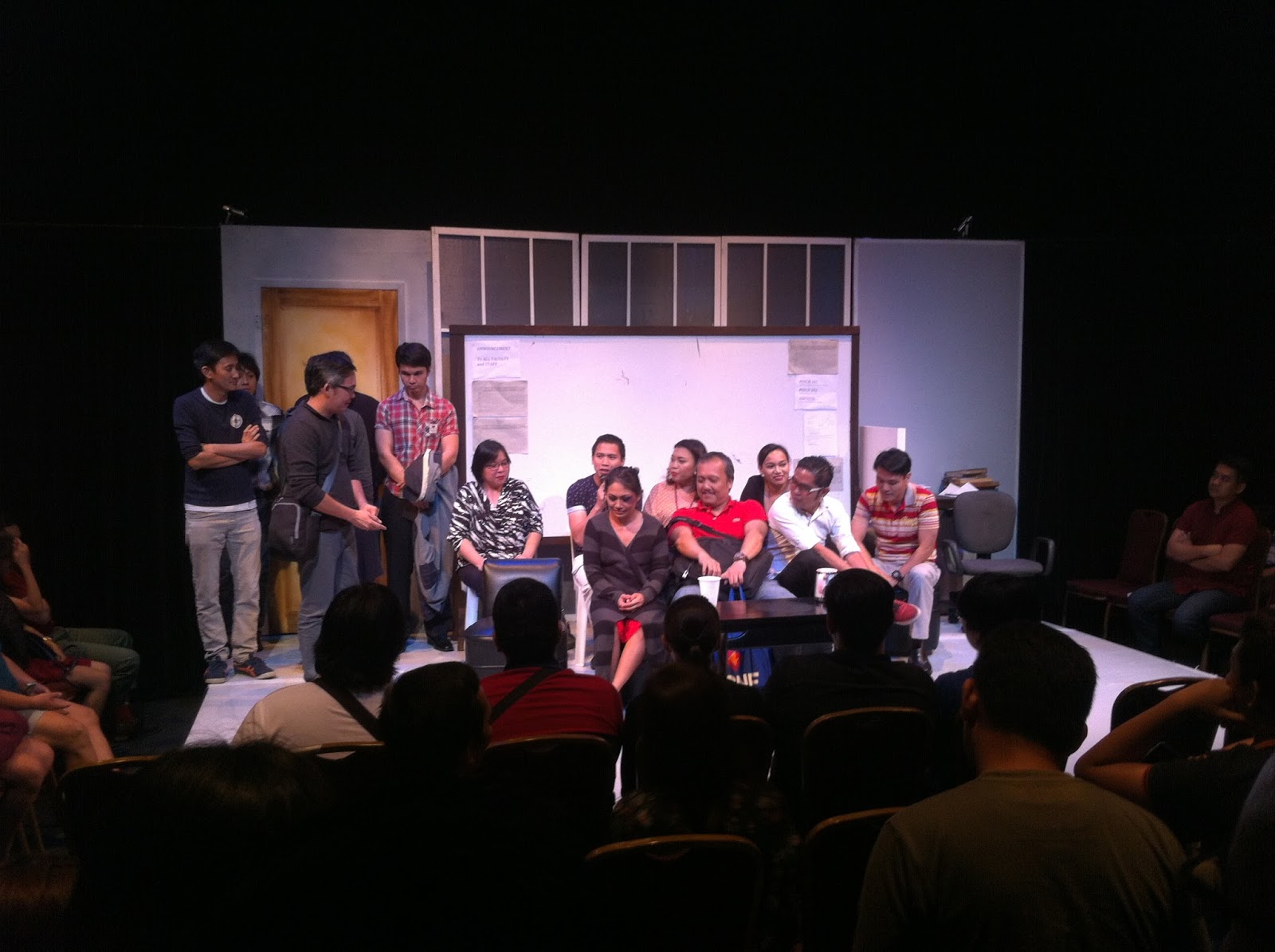
But De Jesus' heartbreak music, his assiduous exploration of pain and cruel suffering and love crushed and splintered, is of a different category altogether. At the Cultural Center of the Philippines' (CCP) Tanghalang Aurelio Tolentino last Sept. 24, the illustrious career of this much-garlanded songwriter-actor-musical director received a thrilling, almost unbearably melancholy condensation through the aptly titled "Demented, Delightful, Deranged, De Jesus," the second of this year's Triple Threats concert series.

Versatility

Thirty-nine artists, like pilgrims at the shrine, performed the two-hour set list, which mostly contained De Jesus' musical theater work--"Care Divas," "Zsazsa Zaturnnah," "Himala, The Musical"--interwoven with selections from his album "Songs to Slash Your Wrists By" (how fitting!) and his compositions for the screen, such as the theme from Mark Meily's "Crying Ladies."

It was an impressive display of versatility (and even this phrase seems an inadequate modifier). For De Jesus' body of work runs a gamut of styles and moods, from inspiring patriotism ("Pag-asa ng Bayan" from "Batang Rizal") to brusque elation ("Babae na Ako" from "Zsazsa," performed by Eula Valdes) to heart-tugging, brain-numbing, vaguely soul-crushing romance ("There'll Be Trouble" from "Leading Lady," with original cast members Giannina Ocampo, Hans Eckstein and Bituin Escalante).

And it's that last kind that De Jesus' does exceptionally well. In fact, looking back, the concert felt like a slow descent into a wellspring of tears.

"Here's another happy song," became the evening's oft-spoken sardonic gag, the titles speaking for themselves as they flew by: "Hindi na Kita Mahal," "Ako Lang ang Nagmahal," "Sapagkat Mahal Kita," etc.

Sharp images

It's the language of betrayed lovers and disillusioned romantics that De Jesus speaks most fluently, his images sharp, the voices distinct, the metaphors savagely hard-hitting and honest.

Take this hint of hurt from "Ang Maamong Mukha ng Pag-ibig Mong Sinungaling," which De Jesus himself performed: "Iwan mo na lang sa unan ang amoy ng iyong pagtataksil. Akin yan."

Or from "Tahimik Lang," achingly sung by Reuben Laurente, in which emotional damage masquerades as silence: "Walang tunog kapag ang luha'y pumapatak/at ang pusong sumisigaw, walang nakakarinig/at ang labing napipi, gusto mang magsumbong, tahimik lang."

To use the expression: hashtag "hugot." Whether in English or Filipino, the truthful clarity of De Jesus' lyrics is never diminished.

And come those lung-busting aria--such as "Kasalanan Ko" from "Leading Lady," which only Escalante could possibly render with such crushing anguish--one could only surrender to the sweeping sensory overload.

It's moments like this--and "Demented, Delightful, Deranged, De Jesus" had them aplenty--when the human heart is transported to a most vulnerable, searing spot. When that happens, it's best not to hold back; instead, one just has to surrender to this genius' sweetly painful music. Your heart will surprisingly thank you for it.

Saturday, October 10, 2015

PDI Review: 'Breakups and Breakdowns' by Ateneo Blue Repertory

I saw three shows last weekend: Tanghalang Ateneo's "Robot Unibersal ni Rossum," a confusingly flamboyant adaptation of the Karel Capek play; Ballet Manila's "Romeo and Juliet," using Paul Vasterling's choreography--Rudy de Dios as Romeo, Gerardo Francisco as Mercutio and Rudolph Capongcol as Benvolio were excellent; and Blue Rep's "Breakups and Breakdowns," which turned out to be the weekend's pleasant surprise--the online version of my review in today's paper here.

*     *     *     *     *

Blue Rep and 'Breakups and Breakdowns' make a surprising match


You'd be hard-pressed to find a more agreeable onstage marriage between man and material these days than at the Ateneo's Fine Arts Theater, where Blue Repertory's "Breakups and Breakdowns" closes tonight after a three-week run.

Despite the middling material--book and lyrics by Joel Trinidad, score by Rony Fortich--it's marvelous how "Breakups" gels so seamlessly with the capabilities and sensibilities of its young performers, this small band of college students finding youthful vitality in a sea of banality.

Trinidad's writing flounders in shades of all-too-eager cleverness and not-too-deep heartache, a mixture obviously patterned (but not perfected) after American TV sitcoms such as "Friends" and "How I Met Your Mother." It's the choice of entertainment of the modern, young and educated, in which jokes are exchanged at lightning speed and romances wither in the blink of an eye.

"Breakups" presents us with a foursome--roommates Mark and Derek, and the women in their lives, graphic designer Nina and (what's her description again?) Sandy--singing largely forgettable music about falling in and out of love (though, admittedly, Fortich has woven a couple of memorable moments in "Boy Meets Girl" and "Tell Yourself").

Privileged people

Where new ground is concerned, none is broken by "Breakups." It's another millennial story of privileged people dealing with their First World problems. We've seen this before in The Sandbox Collective's "No Filter," a monologue series about the middle-to-upper class millennials of Manila, which is currently enjoying a second run at the Black Box Theater in The Circuit, Makati City.

Whereas "No Filter" generates its appeal largely through the inspired writing, Blue Repertory's "Breakups" simply has to look around and within itself. It's the English-spouting millennial Atenean stereotype at play, but really, milieu--or people's perception of it, at least--has never played a more integral part in the relative success of a show.

As the perfect company to put on an English-language show about vaguely American people and their love problems, Blue Repertory more than delivers; this "Breakups" has a beating heart that is as familiar as it is convincingly alive.

Not for a second do we doubt that these performers can indeed assume these fictional identities; the glass slippers fit perfectly, so to speak. That, and the fact that Reb Atadero's direction is an admirable exercise in restraint and streamlining.

Devices are employed sparingly but effectively. In a particularly stirring rendering of romantic irony during the opening song, the sight of Mark and Nina kissing for what appears to be the first time is contrasted with voice-overs of missed telephone calls and glum good-byes.

The girls in particular--Celine Bengzon as Nina and Angela Mercado as Sandy--emanate a kind of radiant freshness generally seen only among the pros. They sing ravishingly and never overdo their acting; they could very well be the people they're portraying, and we'd totally buy it.

Comfort

It's this comfort with the material that ignites the enjoyment in "Breakups," even though the choreography could use more polish and theatricality, and the singing becomes tentative when it comes to those insipid low notes (not the performers' fault).

Doomed lovers' quartets are, in fact, nothing new. Patrick Marber's "Closer," last staged in Manila two years ago by Red Turnip Theater, is the quintessential example. (Perhaps viewers are more familiar with it through the 2004 film starring Natalie Portman and Julia Roberts.)

It would be quite a stretch to call "Breakups" a "Closer" for a G-rated audience. The latter features thrilling verbal jousts, each person clawing at the other's veneer, willed to expose his or her frailties--a Russian roulette of toxic romances set to the foul language of distrust and betrayal.

"Breakups" has nowhere near as much emotional gravity. Mostly, it attempts to be serious, and be taken seriously, then retreats to its cozy shell of familiarity. But as staged by Blue Repertory, the conflicts unexpectedly become compelling, and the people in it, real. Or as millennials would say it, totally relatable.

Sunday, September 27, 2015

PDI Review: 'Mundong Entablado' by the One Night Stand cabaret series

It was a privilege to write this piece--the website version here. To many more smashing nights like this at the One Night Stand cabaret. 

*     *     *     *     *

'Mundong Entablado': A sensational night for the original Filipino musical

"Pambayad ng trophy!" chirped Nonie Buencamino during the opening spiel of "Mundong Entablado," the one-night-only fund-raising concert for the Philippine Legitimate Stage Artists' Group (Philstage) held Sept. 1 at 12 Monkeys Music Hall & Pub in Century City Mall, Makati City.

The "trophy" in question was a jocular reference to the Gawad Buhay! Awards for the Performing Arts, which Philstage has been handing out for the past seven years in a ceremony that, while definitely no match against the scale and spectacle of the Aliw Awards, can already claim to be the most legitimate of its kind.

Festive reunion

"Mundong Entablado," the fifth edition of the One Night Stand cabaret series pioneered by Joaquin Valdes, Chinie Concepcion and Mica Pineda, proved to be more festive reunion than concert, like one huge artistic family coming together for two hours of belting and repartee. The air was rife with familiarity, the sense of celebration quite infectious.

Since its inception last April, One Night Stand had so far been about uneven singing and tipsy bantering, its theme nights providing a venue for theater actors to let their hair down and let the alcohol do half the talking and singing (in keeping with the art form's true spirit).

Last month's edition was a glorious departure from the mold: Carla Guevara-Laforteza's 40th birthday concert. It was a scorcher of an evening, her take on Andrew Lloyd Webber's "Unexpected Song" quite the bravura showstopper, one of those ephemeral moments theater worshipers live for.

"Mundong Entablado," directed by Topper Fabregas, deigned to raise the bar even higher for the monthly cabaret: Its theme was the original Filipino musical.

Even in timing, it was already a cheeky move. Only a year ago, theatergoers and the culture-loving public were treated to something rather similar, but of much grander proportions: "Musikal!"--the 45th anniversary concert of the Cultural Center of the Philippines (CCP).

"It was a night bigger than any other," we wrote, as the who's who of the local performing arts descended upon the palatial Tanghalang Nicanor Abelardo in a starry rendezvous.

Smaller setup

"Mundong Entablado" was a much smaller setup with fewer performers--downscaled to the max, to use the pedestrian expression.

But the concert itself was, in a word, sensational. Buencamino, together with Bituin Escalante, Sweet Plantado-Tiongson, Cris Villonco, Kim Molina, OJ Mariano and Sandino Martin--all of them having starred in original Filipino musicals--stormed the stage and, again, to use a common phrase, sang the hell out of the night.

Count them--17 numbers, including four medleys, representing 16 musicals. Still, already clocking in at a little over two hours, the selection felt oddly limited.

For one, there was the lack of English language work such as Trumpets' visually stunning "The Bluebird of Happiness," or 4th Wall Theatre Company's "Rivalry."

And, given that more than half of the selection were musicals shown within the last five years or so, this ostensible preference for recent work missed the likes of Dulaang UP's (DUP) "Ang Nawalang Kapatid" and "Ang Huling Lagda ni Apolinario Mabini"--both premiered splashily to acclaim last year--or the Philippine Educational Theater Association (Peta) warhorse "Care Divas," or the late great Mario O'Hara's "Stageshow" (in which Buencamino danced up quite a storm three years ago).

More original Filipino musicals are being staged and restaged these days, and more importantly, being patronized by audiences. Parallel to this happy development, the days when exclusivity and territoriality governed the country's various theater companies appear to have largely vanished now, with everyone from directors to designers freely hopping from one company to another, wherever work may be found.

It's a tighter, more harmonious community, where the goal is simply to put on a darn good show.

Bountiful age

Look no further for proof of this bountiful age than in Peta's "Rak of Aegis," which, having played more than 200 shows in less than two years, already occupies its own legendary perch in the industry. Beyond being a wildly entertaining work, it has also become sort of a gold standard in crafting a jukebox musical.

That "Musikal!" and "Mundong Entablado" each utilized medleys of those vocal cord-busting Aegis songs as act enders must speak only of the clout Myke Salomon's revitalizing orchestrations have acquired.

An even better example of the genre (to us, at least) is Culture Shock Production's "Sa Wakas," the middle-class love triangle told in reverse in the style of Stephen Sondheim's "Merrily We Roll Along," that employed songs by the now defunct band Sugarfree.

Hearing Villonco, Martin and Molina tear through "Prom," "Ikaw Pala" and "Bawat Daan" (an original song written specifically for the stage) was a ravishing reminder of the heart-tugging beauty those songs, rearranged by Ejay Yatco, possess.

Or how about Dalanghita Productions' "Kung Paano Ako Naging Leading Lady," which this year became local theater's version of a summer blockbuster? It was a laugh trip from start to finish (and featured what is, in our book, the year's best musical theater performance so far--Molina's as the ambitious Viva). The last time a fantastical superhero musical hit this big was the Tanghalang Pilipino moneymaker "ZsaZsa Zaturnnah."

Inspiration

These days, historical work also remains a reliable source of inspiration. Ryan Cayabyab's take on the illustrious Jose Rizal novels are already in a league of their own, represented during the concert by Buencamino's haunting "Awit ni Isagani" from "El Filibusterismo," and Plantado-Tiongson's medley of "Awit ni Maria" and "Awit ni Sisa" from "Noli Me Tángere" ("The nerve!" she exclaimed at the end, a finger pointed at herself, to laughs and cheers).

In less than a year, we've also had two musicals on Apolinario Mabini: Floy Quintos' "Huling Lagda" (gloriously sung and passionately acted) and Tanghalang Pilipino's radically reimagined "Mabining Mandirigma," starring a subtly powerful Delphine Buencamino as a female Mabini.

There's even "The Mahabharata," which became "Ang Nawalang Kapatid" ("the year's best and most complex dancing," we wrote in our theater roundup last year, by DUP's talented corps of student-actors).

The movies, too, have had their slice of the stage. "Himala, The Musical" provided the medley that thunderously concluded "Mundong Entablado." Scored by Vincent de Jesus, it was last staged three years ago in concert form starring May Bayot, Isay Alvarez and Dulce (the last two the same powerhouse duo that anchored the 2013 revival of what is widely considered the mother of original Filipino musicals,  "Katy!").

Now, there's "Maxie the Musicale," an ebullient and entertaining, if unevenly written, take on Auraeus Solito's award-winning film; and yes, despite all that's been said of it, even Resorts World Manila's crowd-pleasing "Bituing Walang Ningning," adapted from the Sharon Cuneta-Cherie Gil classic.

More than anything, "Mundong Entablado" was a splendid reminder of where the original Filipino musical is right now: front and center of our stages. May it never leave that spot, and may it rain trophies on anyone who's doing his or her share to help it live on forever.

Saturday, September 19, 2015

PDI Review: 'South Pacific in Concert' by Resorts World Manila

What do Ballet Philippines' "Manhid," Upstart Productions' "Into the Woods," Resorts World's "Bituing Walang Ningning," and PETA's revival of "Noli and Fili Dekada Dos Mil" have in common? I shall speak no further.

Anyway, I'm back in the papers after almost two months (thank you, Internal Medicine!). My review of Resorts World's "South Pacific in Concert," which plays its second and final show tonight, is in today's Inquirer--here.

*     *     *     *     *

An enchanting 'South Pacific in Concert,' thanks to an enchanting leading lady

She has dreamed a dream in time gone by as a prostitute in 19th-century France; climbed trees, scraped her knee and torn her dress as a freewheeling nun in Salzburg, Austria; and danced on the last night of the world with her American GI in wartime Saigon.

Now she's on an island in the Pacific, "a cockeyed optimist, immature and incurably green," and don't be surprised if you find yourself falling in love with this wonderful gal as the night wears on.

Such is the sweeping charm of Joanna Ampil, eminent star of the West End's "Miss Saigon" and "Les Miserables," who gives a performance of crystalline delicacy and unbridled buoyancy in Resorts World Manila's concert presentation of Rodgers and Hammerstein's Pulitzer Prize-winning "South Pacific," directed by Menchu Lauchengco-Yulo.

The musical, last staged in Manila in 1997 by Repertory Philippines, is a map of two love stories on a South Pacific island in the midst of the Second World War: that of Nellie Forbush, a self-confessed hick of a US Navy nurse, with the French plantation owner Emile de Becque; and that of Lt. Cable with the virginal islander Liat, who is disturbingly paired with the former by her scheming mother Bloody Mary.

Deeply humanizing

For two nights only (it plays its second and final show tonight), Ampil sings the part of Nellie. Yet, not for a minute does she make it seem as if she's only there to hit those notes. Employing the most convincing Southern accent we've heard in the theater of late, Ampil locates a deeply humanizing core in the character, and the result is a perceptively shaded portrait of a woman who can be schmaltzy lover, animated friend and prejudiced stranger all at the same time.

It is largely to Ampil's credit that this discreetly abridged staging of "South Pacific" feels as if it were the real thing. Her Nellie is all flesh and burbling blood, and the subtly lacerating work she puts into the first act's final scene, when Nellie discovers Emile's past relationship with a Polynesian woman and her bigoted side surfaces ("Colored," she exclaims), erases any sliver of doubt that somebody else could possibly do the role, should the producers decide to put on the real thing.

Ampil finds an able match in opera singer Jon Meer Vera Perez as Emile. Though he tends to scrunch his face too much to convey expression--unfortunately captured all too clearly by the tawdry video projections on both sides of the stage--Vera Perez is nonetheless a commanding presence, alluring and faintly vulnerable.

And boy, does the music soar with his voice; his "Some Enchanted Evening" and "This Nearly Was Mine" are two of the show's genuinely thrilling numbers.

Underwhelming

Meanwhile, Ima Castro cuts a voluptuous, if slightly youthful, figure as Bloody Mary. But her performance makes you wonder at the possibilities that the likes of Sheila Francisco (who played the role to acclaim in London's National Theatre in the early 2000s, and can be heard in that production's cast recording) could have realized.

Castro is not at all inadequate; she's just underwhelming, lacking in heft and power, and while she exudes the character's air of lecherous mystery--a trait that could imaginably work to her advantage in a full-on staging--her remarkably high vocal range never really finds complete comfort in the score.

It's this same problem with low notes that hounded her otherwise busty portrayal of the beachside siren Saraghina--Bloody Mary's long-lost Italian relative, if you may--in Atlantis Productions' "Nine" three years ago.

It isn't any better for Mark Bautista as Lt. Cable. A pop star by nature, he was a dashing delight in Resorts World's "Bituing Walang Ningning," one of the few pleasures to be had in that otherwise deeply problematic production (but let's not get carried away now).

But here, where the score leans towards traditional Broadway and, occasionally, the near-operatic, Bautista is visibly uneasy with the sustained notes, the lack of wiggle room for riffs and bends, and sadly, yes, even his character's few high notes.

Sumptuous playing

That is unfortunate, because Rogers' music has never sounded richer, more luscious, more alive, than in the sumptuous playing by the Manila Philharmonic Orchestra under the baton of Rodel Colmenar. A particularly ingenious moment during the overture hints at the dark underbelly of this deceptively sunny musical, when the lilting strains of "I'm in Love with a Wonderful Guy" are contrasted with images of skyrocketing bombs and mushroom clouds on the LED screens onstage.

The ensemble, too, does fine vocal work (and curiously enough, they seem to have crossed over en masse from Dalanghita Productions' earlier smash musical "Kung Paano Ako Naging Leading Lady").

If there's any displeasure to be had in this concert, it is the sound. You'd think, given that this is only a two-night affair--and a concert at that, where the voices, the singing and the sound should be the focus--that they'd have somehow perfected all the acoustic elements.

Yet, opening night was marred by mic scratches and irritating reverb and infuriating audio feedback. Ampil even had to do her first scene with a handheld microphone, which came several inaudible lines too late. But this seasoned pro carried on as if nothing were wrong and never once struck a false note.

If this "South Pacific" makes for an enchanting evening in the too-capacious Newport Performing Arts Theater, it is, for the most part, thanks to its enchanting leading lady.

Sunday, August 16, 2015

The Lovely Month of July

Pretty bad last two days. We're in Internal Medicine now, and I received this patient who almost bled to death. End-stage kidney failure, and she developed uremia, a condition in which all the vile nitrogenous waste in your blood can't be excreted by your kidneys (because they're too damaged to function), so your body essentially goes nuts--one manifestation of which is developing ulcers that can and will bleed terribly. Woman's in the ICU now (we really thought she wouldn't last the night, which came as quite a heavenly surprise that I woke up the following morning without a text message declaring her demise). Don't get me wrong, though: I love Internal Medicine. It's one of my three choices for residency (along with psychiatry and ophthalmology). There, now you know.

REAL-TIME UPDATE: We just coded/CPR-ed a patient. He died.

*     *     *     *     *

Internship really is the best year. July for our block was a vacation, a time when I'd catch myself thinking, Hey, your mind ain't thinkin' nothin'. Just... zen. 

It started with us decorating our big-assed friend Justin's car.


*     *     *     *     *

We went to Pinto Art Museum in Antipolo City, and the best thing about it is that it's right along the path of NAIA's departures and arrivals. I saw Eva Air's A330, for one.

This is Pia, being a pabebe.


Pinto is pretty big, and we realized you need an entire day to really appreciate everything (we only allotted three hours, and then we were hypoglycemic and were racing to Capitolyo and landed in Poco Deli). 


So much of Pinto seems inspired by Santorini, the most hackneyed place in Greece. 


My favorite exhibits:

"Quiapo Ibabaw," oil on canvas by Emmanuel Garibay, 1993.  

"Prusisyon," acrylic on canvas by Neil Manalo, 2011.

A taxidermy of something.

"The Hollow Man," wire and resin by Alab Pagarigan, 2013.

Pia completing Daniel dela Cruz's "Pilgrimage."

Church in a slanted world.

UST overrun by rats.

Carmela playing Joan of Arc/Disney's Esmeralda. 

I recreated a scene from John Logan's "Red"--the painter Mark Rothko, with his back to the audience, in front of a bloody red canvas. Unfortunately, few people got the reference when I posted this in Facebook. I was embarrassed on their behalf.


We had our graduation photo shoot. Can you believe it's been almost seven years?


The House of Yu in Café Chosun, Adriatico cor. Pedro Gil St., Malate, Manila.


*     *     *     *     *

Carmela and I went to Avilon Zoo on a Thursday. (The psychiatrists had their convention, so the out-patient clinics got cancelled for that day.) Apart from us, there were only two other visitors in that 7.5-hectare slice of paradise, where sagely hornbills and hungry arapaimas greeted you at the entrance.


Lions! 

African leopard.

A fat, extremely cuddly black bear.

This sun bear was so smart, it managed to get itself on that ledge but couldn't figure out how to get down.

Blackbuck antelopes.

Zebra.

Two pairs of mating tortoises. I have a video--complete with sound effects!--that has the potential to go viral.

A huge-ass Burmese python.

A huge-ass king cobra.

Monocled spitting cobra.

Giraffe!

*    *    *    *   *

Then there was this Sunday when I went to the book sale of one Jason Moss, son of the eminent copywriter Arnold Moss. 15 titles for P300! After that, I went to the PETA Theater Center for the January-June deliberations of the Gawad Buhay! Awards. Yes, am now a member of the jury starting this year. So far, a terrific year for straight plays, and a lousy one for musicals.


Sister Vibered this photo of mother during her birthday.

Saturday, August 1, 2015

PDI Review: 'No Filter: Let's Talk About Me' by The Sandbox Collective

My review of "No Filter" is in today's Inquirer--here. To all the conyo kids out there, this is your show! Get off your ass and go see it! Book a couple of tickets and text a friend, "Hey, I'm watching No Filter, wanna come with?" It's not your usual house party chismisan, swear, and if you have a car, then it'll be so not hassle. Bro.

*     *     *     *     *

Navel-gazing made eloquent and fascinating

(L-R): Mikael Daez, Saab Magalona-Bacarro, Jasmine Curtis-Smith, Cai Cortez, Khalil Kaimo.

"A play by millennials for millennials about millennials" is how The Sandbox Collective's latest production, "No Filter: Let's Talk About Me," fancies itself--a two-hour, 19-monologue original work.

The tagline is nothing if not fitting: This is such a self-absorbed piece of theater--and that's an excellent thing. So deep is its fascination with its subjects and its devotion to exploring every inch of their skins that the result drips with earnest sincerity.

Dishonesty is this show's idea of hell, and well-meaning self-deprecation its choice of banter.

But if the tagline sounds smugly all-encompassing, then the invisible sub-clause, the unspoken definition of "millennials," should be pointed out: In this show at least, it's limited to the subset of Metro Manila youth with (more than) enough money to spare for a night at the theater and perhaps a nice late dinner afterwards.

Self-assurance

"No Filter" pokes fun at hangovers and the "Titas" of Manila, assumes the viewer's familiarity with Instagram and Tinder, and believes the struggle with free-cable internet back in the Paleolithic late '90s to have been a universal one.

What is spoken here is the language of the privileged--not exactly the exclusive-school born-and-raised, but those who, at one point in their young lives, might have had to make extremely difficult choices on matters such as travel, android phones, and heaven bless them, the perfect outfit.

If you identify with these people, then yes, this is the show for you. The "feels," as kids these days are wont to say, run aplenty, and so do the laughs and maybe even tears.

As for the rest of the common folk, fret not. It isn't everyday--heck, every year--that an original English-language Filipino work blazes our way with this eloquence and self-assurance.

What comprises half the appeal of "No Filter" is its script: a potpourri of "First World problems" taking the form of persuasive, vividly written confessions. (And take note, titos and titas, the phrase "First World problems" isn't meant to be taken literally.)

"When the thing you love most becomes your work, it becomes the hanging noose that might just kill you," goes one line, and you immediately wish every English-spouting private-school graduate could actually write like this.

"Love Me Tinder" humorously ascribes a disproportionate amount of intellectual discernment to the frivolity of the online dating/friendship-forming/soul-mate-searching app. "Moving Out" convinces us that moving to New York to fake one's death is the right thing to do.

Ideal companion

If not always powerful, these monologues simply ooze with passion. And they find an ideal companion in director Toff de Venecia's unembellished staging and the performances he has extracted from his cast, half of which are making their stage debuts.

The challenge for them, one realizes, is not "to act," to alter voice, movement and expression and assume a vastly different identity, but to "tweak" their personalities just a little, to ensure that they aren't just playing themselves, or their siblings, or their neighbors, but the writer--someone with probably the same privileged background as theirs, whose world intersects with theirs through countless similarities, but whose back story can be miles different.

It is a challenge that this cast, more often than not, handles with surprising ease and confidence.

And so we have fashion blogger Saab Magalona-Bacarro making quite the cogent, heartfelt case for the writer who faked her death in the Bronx; or Jasmine Curtis-Smith effortlessly shifting between contrasting emotions in "The Interview," about a writer who must deal with her own anxiety in front of her potential employer; or Cai Cortez charismatically saying that, yes, plus-sized women get to be choosy on Tinder, too.

That this production is already wrapping up its six-performance run this weekend only makes you wish that these women would consider going back onstage soon. (A limited extension is set for Aug. 7, 8PM; and Aug. 8, 7PM. --Ed.)

The big achievement of "No Filter," a show dedicated to the generation that purportedly loves to talk about itself, is to make self-absorption an appealing attribute. And if the characters talk in such a fascinatingly articulate manner, listening to them rant about their issues--ranging from the downright vapid ("When did dating become such a mindf*ck?") to the subliminally vital ("We're only trying to make do with the ruined world we inherited")--turns out to be far from a chore.

This review is by a millennial who "took one for the team." See the show to understand what that means.

*     *     *     *     *

Contact numbers: 5856909 or 0917-8996680, or visit Sandbox's Facebook page.

Monday, July 27, 2015

Shame. Shame. Shame. *Rings Bell*

The UP Manila-PGH complex, as seen from University Tower.

It happened after 47 episodes: "Game of Thrones" finally affected me. 

Ned Stark's beheading? This was so Sean Bean. The Red Wedding? Underwhelming. (Plus I wasn't a fan of Catelyn Stark and so was actually quite glad the show had gotten rid of her.) Joffrey's poisoning? A sad occasion; he was my favorite character, as portrayed by Jack Gleeson, who stretched the limits of the ruthless, seemingly unstoppable kontrabida. The blinding of Oberyn Martell? Fun, fun, fun. 

But the army of the dead blitzkrieg-ing Hardhome? Now that was seriously creepy shit, like heart-racing serious creepy shit. I had to watch an episode of "Modern Family" right after to restore the balance of the universe. 

Then we had "The Dance of Dragons," where, in an upsettingly but hilariously question mark-ridden finale, Daenerys rides her dragon and leaves her court behind like, Shit, y'all saved my ass from those fanatics, now I'm flyin' away and y'all just gotta make do without me.

Lastly, "Mother's Mercy." Otherwise known as "Shame. Shame. Shame. *Rings bell* (repeat 1000x)." Hannah Waddingham (yes, I just found out it's her!) deserves a Guest Actress Emmy for playing that mean bitch of a nun. And then they repeatedly stabbed Jon Snow, whom I didn't really care for until he became Lord Commander, and it was how quickly and subtly it all happened that actually made it so powerful. "Game of Thrones" had so far been all about loud, violent, dramatic deaths, and then this. Ouch. Now the Wall is presumably left in the hands of traitors, ingrates and imbeciles. 

If anything, "Mother's Mercy" should be remembered for its many powerful images--Cersei's shorn, dirtied head; Jon Snow's lifeless(?) face against the white of snow and the red of his blood; Melisandre (who is always dressed to undress) looking, for the first time, like her bag of voodoo melted into shit. 

Me? I'm great. Having the time of our lives in our first vacation month of internship. Went to the Pinto Art Museum last Saturday. Been eating in different places. Watching lots of shows. Studying on the side. The works. 

Saturday, July 18, 2015

PDI Review: 'The Normal Heart' by Actor's Actors, Inc.'s The Necessary Theatre

Injustice is "The Normal Heart" running for only one stormy weekend. This is necessary theater, and good thing it's coming back in October. My review is in today's Inquirer--here. Some of you are probably wondering why it only came out today, two weeks after the show's premiere run ended. Well, Wednesday night is our deadline for the theater section, which comes out every Saturday. And as a rule, I don't review preview performances (unless it's a near-perfect show, which is rare). And also, I had my Virgin Labfest reviews for last week's issue, so taddah.

*     *     *     *     *

The heart-shredding 'The Normal Heart'

The Necessary Theatre's production of Larry Kramer's "The Normal Heart" was a fearlessly mounted, thrillingly acted--and distressingly short-lived--show, playing only five performances from July 3-5 at the Carlos P. Romulo Auditorium at RCBC Plaza, Makati City.

Anyone with a heart, regardless of nationality, sexual preference or attention span, was bound to exit the theater bruised, or at the very least, mildly shaken. All those explosive confrontational scenes, the vicious truth-telling and incendiary diatribes, delivered with scalding conviction by a magnificent cast led by Bart Guingona, Topper Fabregas and Roselyn Perez, guaranteed just that.

Three decades since its inception, and thousands of miles away from its Manhattan setting, "The Normal Heart," Kramer's Pulitzer Prize-winner about the early days of the AIDS crisis in New York, has lost none of its blistering power.

It did, in fact, only acquire an added layer of urgency with its timely Manila debut, what with the distressing rise of HIV-AIDS incidence in the country in recent years.

Loud fight

"The Normal Heart," supposedly patterned after real-life events in Kramer's life, is anchored on the character of Ned Weeks, who takes it upon himself to start the big, loud fight against HIV-AIDS at a time when the rest of the world, including his gay friends and the rest of their sex-loving community, would rather be silent, if not blind.

It's a highly dramatic story, to put it bluntly, and in this production, there was really almost nothing to distract the audience's attention from the storytellers. On a bare stage, harshly lit in shades of white, with only the most essential props--tables, blocks for chairs, lots of paper, a carton of milk whose violent end was also met with shock--Guingona and his cast sublimely took it upon themselves to be as transparent and vulnerable as possible, to sensational effect.

But the beauty of this production, which Guingona also directed, was in its refusal to be a mere provocative polemical drama--although as that, it was quite compelling. Rather, this "Normal Heart" was more a character study, a meticulous dissection of several fictional individuals, in our view, by the tightest ensemble to have graced the stage so far this year.

In their hands, there were neither good guys nor villains--only real people, with motivations and principles and conflicts. And so when they fought, we watched, felt for them, even shed a tear or two for them, but hardly took sides. It was a plagued community in danger of collapsing onto itself, and we could actually understand why.

Most affecting

Kramer's language--at once vicious and playful, verbose and vivid, and most affecting when delivered in brutal spurts--requires a certain level of theatrical skill and verbal dexterity to pull off.

What's more, each character gets at least one extended dazzling moment in the spotlight, an opportunity to vent his rage and scream at the world. That these actors--Red Concepcion, Jef Flores, Nor Domingo and TJ Trinidad (in a superb, self-assured stage debut), playing gay men who couldn't be more different from each other--made it seem as if the words were flowing out of their brains and mouths for the first time, was also this production's triumph.

As Ned, Guingona showed both the relentless stridency and a hint of coldness intrinsic in the character. We actually understood that he would stop at nothing to fight for what he believes in, that he would wage the noble war even if that means breaking off with his brother (Richard Cunanan, excellent).

It was this blustering portrayal that made it quite clear why Ned would have the perfect partner-in-crime in Emma Brookner, the paraplegic doctor waging her own war against the disease, embodied with shattering authority by Perez.

Life partner

And Guingona's Ned also made the audience see why Felix, the closeted, sophisticated style journalist, would be the perfect life partner for his character. To say that Fabregas, in a gut-wrenching, refreshingly against-type performance that only the most heartless could have survived unmoved, was splendid as Felix would be an understatement. He and Perez were the best things of this "Normal Heart."

The most heartrending exchange in this production was actually almost an aside. Newly diagnosed with AIDS, Felix says, "I wish my mother were here," to which Brookner asks, "Where is she?"

"She's dead," he says, and the way Fabregas uttered those lines, as if the fact were a wisp of autobiographical detail to be shrugged off, sealed the case for casual, unexpected silences as potent tearjerkers.

Poignant silence is rather hard to come by in this play, however. And it's easy to call a show that ends with a treacly deathbed wedding, and that somehow designed every scene to end in a show-stopping monologue, manipulative.

But when it's done this well--an almost divine alignment of acting, scene work, design and direction--who, indeed, are we to resist the melancholic onslaught of tears?

Saturday, July 11, 2015

PDI Review: Virgin Labfest XI

My omnibus reviews of the 12 entries to this year's Virgin Labfest is in today's Inquirer--here. I will not lie: This was exhausting. But theater is love. And hashtag love wins. 

*     *     *     *     *

Set A talkback.

'Sariwa' served two ways at the Virgin Labfest 11

"Sariwa" (fresh) is the theme of Virgin Labfest XI, and what has emerged at the tailend of this annual festival of "untried, unstaged, unpublished" plays, which concludes its three-week run tomorrow at the Cultural Center of the Philippines' Tanghalang Huseng Batute, is a kind of accidental dichotomy, the 12 entries of this year's roster having somehow found a way to tackle the central motif in two distinct ways.

There is the obvious: "sariwa" denoting freshness, a departure from the old and stale, which is the principal appeal of the Labfest's three best entries--Maynard Manansala's "Dalawang Gabi," Jerome Ignacio's "Kublihan," and Eljay Castro Deldoc's "Si Maria Isabella at ang Guryon ng mga Tala"--and not only because each features at least one bright new talent at the helm.

'Dalawang Gabi'

Manansala's "Dalawang Gabi," directed by Jade Castro, should be essential study material for people who aspire to write comedy. By virtue of crisp, naturalistic dialogue, it transforms a platitudinous subject--the teacher-student relationship, and not the pedagogical kind--into something riotous and refreshing, dated Alma Moreno jokes and all.

Just as Debbie (Meann Espinosa) is about to profess her love to her former student Lester (Ibarra Guballa) in hilarious fashion that involves a gaudily decorated bulletin board, he tells her he's engaged.

Two years later, the tables are turned. Here, Espinosa and her usual first-rate comic chops ("Hindi ako bumabata, bumibigat lang," she deadpans), and Guballa, in a breakthrough performance that demonstrates through the slightest gestures and silence the brutality of heartbreak, achieve a fine brew of hilarity and poignancy.

'Kublihan'

A different sort of sadness, one that echoes the us-against-the-world complex hounding the kids of Frank Wedekind's "Spring Awakening" and Han Ong's "Middle Finger," courses through "Kublihan," directed by Guelan Luarca. As written by Ignacio, this Labfest's breakout playwright, it is almost Chekovian in the way the unspoken does most of the elegant storytelling.

Two friends meet at their secret spot--a bench overlooking Marikina Valley in a school not named Ateneo--for possibly the last time, and what starts out as seemingly harmless bantering eventually surprises the audience with stifled feelings and electric revelations.

In this elegiac examination of a friendship in transition, Abner Delina Jr. as the flighty, kinetic senior, and Joshua Tayco as the introverted freshman, provide two of the festival's most nuanced performances--quietly powerful and nearly devastating.

'Si Maria Isabella at ang Guryon ng mga Tala'

Stagecraft and imagination take center stage in "Si Maria Isabella at ang Guryon ng mga Tala," Deldoc's adaptation of Dean Francis Alfar's "The Kite of Stars." It's about a young girl who goes on a lifetime's quest to build a kite that can send her to the stars.

And what fantasy! As directed by the visionary Ed Lacson Jr., this play is hands down the Labfest's most audaciously mounted production, a dazzling union of puppetry and shadow play, lights and shapes and images and sounds, bringing sparkling life to what would seem like an impossible transposition. And the comfort with the archaic Filipino of the script evinced by the vibrant young ensemble, led by the incandescent Krystle Valentino as Maria Isabella, is laudable.

'Huling Huli'

There is also a worthy contender for next year's Labfest's Revisited set in Herlyn Alegre's "Huling Huli," about women who engage in the desperate sex-for-fish trade.

On a desolate stage, punctuated by the constant presence of a fishing boat and frayed fishing nets, director Lawrence Fajardo once again demonstrates a flair for the operatic (evidenced in his award-winning film "Imbisibol," itself adapted from the eponymous Labfest play of two years ago). 

Peewee O'Hara, Mailes Kanapi and the luminous Martha Comia as a virginal young woman on the cusp of a ruthless sexual awakening play three generations of women and virtually sear the stage with their intense performances.

In the end, when the nets finally straddle even the fourth wall and doom these characters to entrapment in their way of life, you can only feel real pity for them.

'Birtwal'

In José T. Garcia's "Birtwal," "sariwa" is in the staging. As the dialogue occurs through text message, the lines are slyly flashed on overhead screens, while the actors (J-mee Katanyag and Ron Capinding, as online lovers meeting for the first time in the mall) engage in a carefully orchestrated wordless dance.

What could have been a dreary and dragging experiment happily finds a hook and captures our attention, thanks to director-choreographer Audie Gemora, who brings an actor's eye to the proceedings to produce an entrancing, altogether original experience. We know it could only end one of two ways, yet we still hang on to every second in anticipation of the inevitable.

'Uod, Butete at si Myrna'

And then, there were the plays that somehow took pleasure in their sweetly ironic treatment of "sariwa" by being about characters who are past their prime, longing for attention, unwanted, "un-fresh."

In Layeta Bucoy's "Uod, Butete at si Myrna," directed by George de Jesus III, the divine Angeli Bayani plays Myrna, a prostitute who was once her barangay's go-to whore, and her lover is the stutterer Uod (a convincing Ross Pesigan). "Konting atensyon, konting malasakit, konting drama" is what she desires, and the audience is served exactly that, in provocative, disgusting ways that make the theater reek of squalor: the couple unabashedly having sex; a grippingly detailed narration of a grisly child rape; and, in a wickedly humorous sequence, Bayani, her character now dead, getting trussed up in layers of cloth and plastic.

Unfortunately, a jarring shift in tone that occurs midway through the play reveals the narrative's shortcomings. Chief among our grievances: Characters don't exist in a vacuum as idealized caricatures unaffected by setting and context. In this play, the established scenery of a cramped railway hovel where secrets are impossible to keep, especially among people who have known each other for a lifetime, simply works against the story's supposedly shocking twist.

'Macho Dancer: A Musical'

Nicolas Pichay's "Macho Dancer: A Musical" is about five macho dancers in a washed-out club rehearsing for a final show to end all final shows. At some point during this inebriated musical, the guys start singing "Everything is beautiful at the Po-Mo" (referring to a fictional postmodern dance school), and immediately, Broadway enthusiasts are bound to think, "'A Chorus Line' Meets 'Follies.'"

While gifted with a taut ensemble led by Riki Benedicto and Paolo O'Hara, this entry, directed by Ralph Peña, is also overstuffed and strangely scatterbrained: too many storytelling devices; an almost pathological obsession with Hindu culture; and not enough time for character and scene development.

Perhaps the glow-in-the-dark elephant that appears at the end of this musical can help solve its rumbling identity crisis.

'Ang Nanay Kong Ex-NPA'

The estranged mother-daughter meet-up cliché is revisited in "Ang Nanay Kong Ex-NPA," an attempt to take us back to the degenerate Marcos regime.

Yet, as written by Mario Mendez and Genevieve Asenjo (who also wrote the novel from which this story is culled) and directed by Rody Vera, it probably would have worked better as a radio drama, or even a tell-all talk show hosted by Kris Aquino.

This exhausting production could have been a more transporting memory play with more capable actresses--one who could vividly shade the mother's meandering recollection of a fateful night during Martial Law, and another who could imbue the daughter with equal measures of tenderness and ferocity.

'An Expected'

Alvin Molina's "An Expected," directed by Roobak Valle, has "missed opportunity" written all over it in neon-pink calligraphy. What could have been an insightful two-hander about a young gay couple clashing over love and principles is reduced to shtick and whimsy with the addition of an imaginary fairy character. Serious conversation gets rudely interrupted by unnecessary comments, and too often, it's like the writer is stopping himself from going "that deep."

It is delightful to watch Gio Gahol perceptively tear through the part of the modern gay man; frustrating that Acey Aguilar, as Gahol's character's confused lover, gets all the didactic and moralizing lines; and annoying that the play expects everybody to accept unquestioningly the existence of the darned fairy.

'When Sam Met Jo'

Job Pagsibigan's sci-fi rom-com "When Sam Met Jo," directed by Ian Segarra, is another missed opportunity, and we don't even have to bring up the overabundance of nosebleed-inducing scientific jargon.

It has its laudable aspects--the time travel bits (the same scene farcically repeated four times). But it would have been better if Randy Villarama, injecting charm and savvy into the character of Sam, had a more adept scene partner (Chic San Agustin in this case) who wasn't as stiff and stilted. Someone who can deliver the line, "Ginawa mo akong renewable energy!", for instance, without making our eyes roll.

'Hintayan ng Langit'

"Hintayan ng Langit," Juan Miguel Severo's crowd-pleaser about aging ex-lovers who meet in the afterlife, directed by Raffy Tejada, proposes some novel ideas. There's purgatory as a transit sauna, for instance, and its flimsy walls as gossamer barriers between the living and the dead. Much of its floundering bulk, however, also unwittingly asks: Does "kilig" alone make a play?

Because truly, many pointless lines and weightless scenes seem to be here more to toy with the viewers' notions of romance than to meaningfully move the story along.

Watching ballet legends Edna Vida and Nonoy Froilan throw quips and witticisms at each other and dance a slow, tender number near the end may prove appealing to most. But a production that does not devote enough attention to character and scene work can only be, in the end, insincere and lightweight.

'Talo ang Walang Alam'

Finally, there's Joe Mari Sanchez's "Talo ang Walang Alam"--distressing proof that a selection committee can be given a pool of 156 newly written plays and still pick something wrong.

What was obviously meant to be yet another indictment of poverty and the ills of society comes across as desiccated, if earnestly made, poverty porn. Not only is it scientifically unsound (nobody gives birth that quick and clean!), it is also suffocating--too much dead air in a production that's already gloomy to begin with.

This production, directed by Issa Lopez, does not break new ground in either subject matter or writing (which is painfully obvious). The staged reading we saw of Ross Manicad's "The Wedding Planners," starring the wonderful Topper Fabregas and Marco Viaña as exes, and helmed by first-time director Jonathan Tadioan, was a way more stirring and emotionally authentic experience.